Sign up here to receive the Market Ethos by email.
If an inverted yield curve is a harbinger of a near-term recession, then a steeper yield curve must be good news, right? Not so fast. Before unpacking that, let’s lay a bit of foundation just in case you don’t follow the shape of various yield curves very closely.
Yield curve basics in 100 words: The yield curve is a measurement of bond yields of various terms from a few months to many years. Most often it has a positive slope, meaning 10-year yields are higher than 2-year yields. Locking your money up for longer should be rewarded with a higher yield (called term premium). Sometimes the yield curve inverts, and short yields are higher than longer yields. This typically happens as short-term yields are more influenced by central bank overnight rates and longer yields by economic expectations. If the central bank is fighting inflation with higher rates and the economy starts to slow, it can invert.
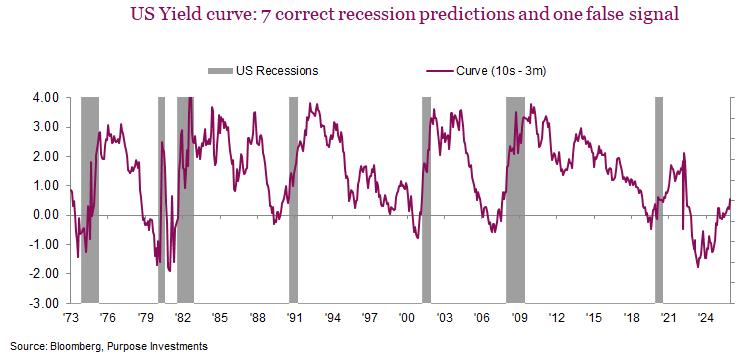
The U.S. yield curve used to have a perfect record signalling recessions, if it inverted, there was a recession coming soon. Seven times this happened, and seven times a recession manifested. It even got the COVID one right, and that was one unique recession. But then it inverted in 2023 and no recession, its only false signal in 50 years. Still, 7 out of 8 ain’t bad.
So clearly, an inverted yield curve is bad, even with that one false signal. Normally a steeper yield curve is good news as it implies higher economic growth expectations (higher longer yields) and/or lower inflation risk (lower short yields). As most countries’ yield curves followed the U.S. from being inverted in 2023, steepening to become flat in 2024 and positively sloped in 2025, this was because inflation risk was falling and economic growth prospects were improving. Yay!!!
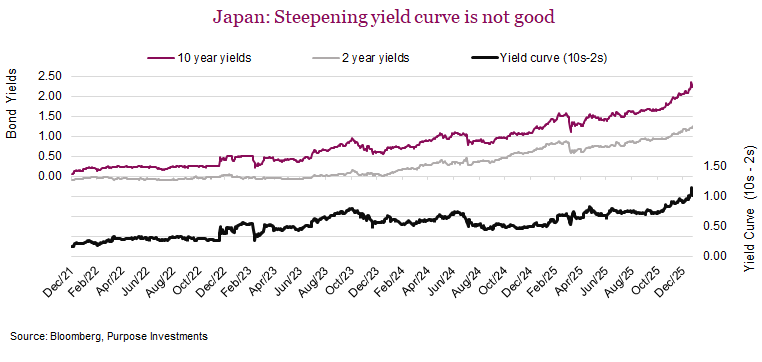
But it is not always good news. Japan’s longer yields moved significantly higher in recent weeks, accelerating a gradual trend that had been in place for a couple of years. The economic outlook for Japan has improved a bit but not enough to justify that move in longer yields. Instead yields moved higher on concerns over inflation and debt sustainability. Japan has been the outlier among central banks, consistently raising short-term interest rates to fight inflation while others are cutting. These higher yields increase the risk of servicing their debt, which is on the large size at 1.2 quadrillion yen or roughly 230% gross debt/GDP. This is bad steepening.
An added wrinkle is that Japan, which has enjoyed very low yields for many years previously, is one of the popular borrowing jurisdictions for the carry trade. Borrow where yields are lower and invest elsewhere. These rising yields make borrowing more expensive for the carry trade, which has been mitigated by a weaker yen. At some point though, these rising yields may cause some unwinding of carry trade positioning, which may hurt asset prices globally.
Diversifiers
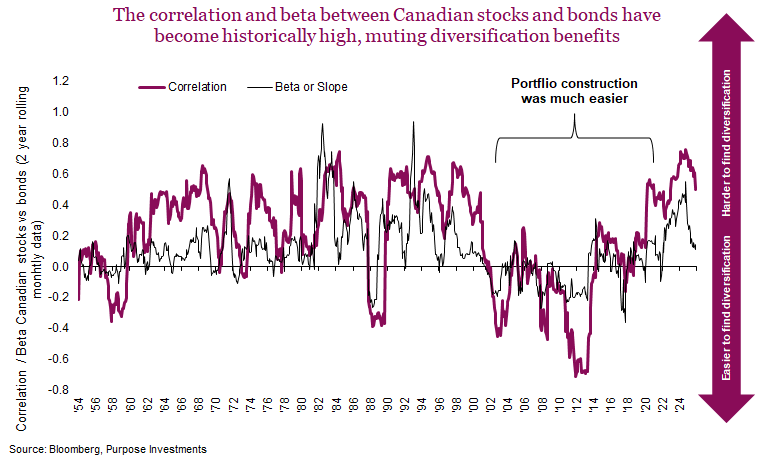
The other issue is from a portfolio construction perspective. If longer yields globally are rising because of fear of inflation or debt sustainability, as opposed to improving economic growth, bonds are not the portfolio stabilizer we all want them to be. Bonds still work really well as a portfolio diversifier if the market has an issue with slowing economic growth or rising recessionary risk. But if the market has an issue with inflation or debt sustainability, bonds probably won’t work well. This is one of the reasons equity/bond correlations have remained elevated over the past few years.
Final thoughts
We do believe inflation and debt sustainability will continue to garner more attention as a risk going forward, and this will likely mute the defensiveness of bonds in a portfolio. This will require different kinds of defence, whether it be holding more cash, commodities, or different diversification strategies. Bonds remain core for defence in case of an economic growth slowdown, but the need for more diversified defence has not been greater in recent history.
Source: Charts are sourced to Bloomberg L.P., Purpose Investments Inc., and Richardson Wealth unless otherwise noted.
The contents of this publication were researched, written and produced by Purpose Investments Inc. and are used by Richardson Wealth Limited for information purposes only.
*This report is authored by Craig Basinger, Chief Market Strategist at Purpose Investments Inc. Effective September 1, 2021, Craig Basinger has transitioned to Purpose Investments Inc.
Disclaimers
Richardson Wealth Limited
The opinions expressed in this report are the opinions of the author and readers should not assume they reflect the opinions or recommendations of Richardson Wealth Limited or its affiliates. Assumptions, opinions and estimates constitute the author’s judgment as of the date of this material and are subject to change without notice. We do not warrant the completeness or accuracy of this material, and it should not be relied upon as such. Before acting on any recommendation, you should consider whether it is suitable for your particular circumstances and, if necessary, seek professional advice. Past performance is not indicative of future results. The comments contained herein are general in nature and are not intended to be, nor should be construed to be, legal or tax advice to any particular individual. Accordingly, individuals should consult their own legal or tax advisors for advice with respect to the tax consequences to them.
Purpose Investments Inc.
Purpose Investments Inc. is a registered securities entity. Commissions, trailing commissions, management fees and expenses all may be associated with investment funds. Please read the prospectus before investing. If the securities are purchased or sold on a stock exchange, you may pay more or receive less than the current net asset value. Investment funds are not guaranteed, their values change frequently and past performance may not be repeated.
Forward Looking Statements
Forward-looking statements are based on current expectations, estimates, forecasts and projections based on beliefs and assumptions made by author. These statements involve risks and uncertainties and are not guarantees of future performance or results and no assurance can be given that these estimates and expectations will prove to have been correct, and actual outcomes and results may differ materially from what is expressed, implied or projected in such forward-looking statements. Assumptions, opinions and estimates constitute the author’s judgment as of the date of this material and are subject to change without notice. Neither Purpose Investments nor Richardson Wealth warrant the completeness or accuracy of this material, and it should not be relied upon as such. Before acting on any recommendation, you should consider whether it is suitable for your particular circumstances and, if necessary, seek professional advice. Past performance is not indicative of future results. These estimates and expectations involve risks and uncertainties and are not guarantees of future performance or results and no assurance can be given that these estimates and expectations will prove to have been correct, and actual outcomes and results may differ materially from what is expressed, implied or projected in such forward-looking statements. Unless required by applicable law, it is not undertaken, and specifically disclaimed, that there is any intention or obligation to update or revise the forward-looking statements, whether as a result of new information, future events or otherwise.
Before acting on any recommendation, you should consider whether it is suitable for your particular circumstances and, if necessary, seek professional advice.
The particulars contained herein were obtained from sources which we believe are reliable but are not guaranteed by us and may be incomplete. This is not an official publication or research report of either Richardson Wealth or Purpose Investments, and this is not to be used as a solicitation in any jurisdiction.
This document is not for public distribution, is for informational purposes only, and is not being delivered to you in the context of an offering of any securities, nor is it a recommendation or solicitation to buy, hold or sell any security.
Richardson Wealth Limited is a subsidiary of iA Financial Corporation Inc. and is not affiliated with James Richardson & Sons, Limited. Richardson Wealth is a trade-mark of James Richardson & Sons, Limited and Richardson Wealth Limited is a licensed user of the mark. Richardson Wealth Limited, Member Canadian Investor Protection Fund.
Related articles
Market Ethos
Running on credit
31 August 2026. Market Ethos. Increased debt issuance can lead to higher economic activity and lift markets, but at what point is it too much…
17 August 2026. Market Ethos. With portfolios heavily U.S. tilted, there are diversification benefits from international which helps reduce portfolio AI exposure risks.