
Market Ethos
26 October 2026
A change in the air
Sign up here to receive the Market Ethos by email.
The market moves through cycles, which we can observe by measuring trends and what types of stocks are starting to outperform. We call this relative strength. Watching it is a bit like watching a wind vane swinging back and forth. Monitoring the movements is important since winds change before the weather does. This month, the vane has swung.
The wind vane: defensives take the lead
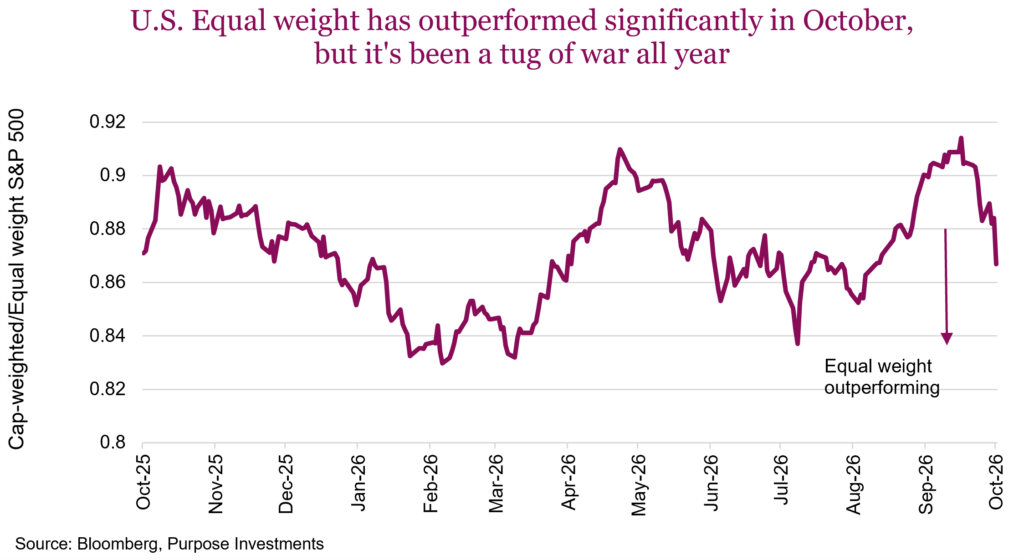
The clearest sign is the resurgence in S&P 500 equal weight versus the cap- weighted index. Last month, the tech heavy cap-weighted index surged; however, in October that quickly reversed. Month-to-date, the equal weighted index is up nearly 5% (as of Oct 22) compared to the cap-weighted index, which is now flat. The equal weighted index is ahead by nearly 5%, and last Thursday had its strongest one-day relative move (+2%) in over two years. Two things are driving the change. The AI trade is still struggling to find firm footing, but we also have seen a surge in areas of the market that were under persistent pressure recently. Consumer staples have been a big winner, up roughly 10% month-to-date, followed by health care. Two of the most defensively oriented sectors are now taking the lead.
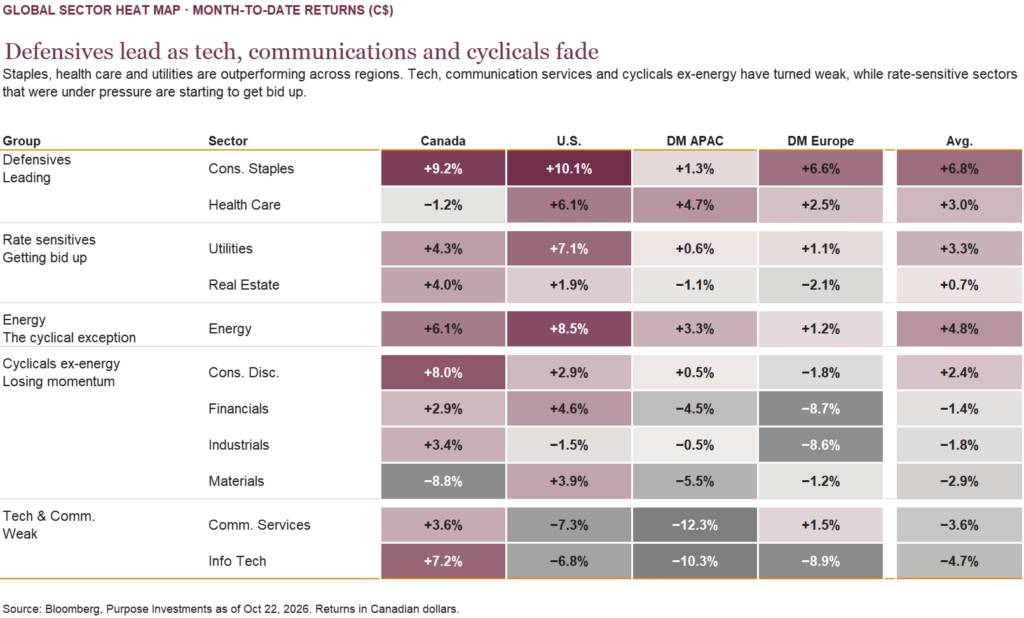
The move isn’t limited to just U.S. staples as seen in the heat-map below. Health care and utilities are outperforming across most developed regions, while technology and communication services (also dominated by big tech) have become quite weak. Canada is a notable exception. Our tech sector is more software and less direct AI exposed. Defensives and rate sensitives which have struggled in recent months due to rising rates have quickly reversed course. Energy is the one cyclical sector that is bucking the trend; it’s still strong, but has its own idiosyncratic drivers.
Factor performance tells the same story. Low volatility, one of the forgotten factors this year, has been the best performer over the past month, followed by quality and dividend yield. Momentum and growth have been under considerable pressure. That’s not surprising, since they’re the two factors most closely tied to tech.
Earnings and AI cracks
It’s still early in earnings season, with just over 10% of S&P 500 companies reported. On the surface, results have been decent. But technology companies, despite beating on both revenue and earnings on average, have been selling off the day after they report. That reflects how high the bar has been set. What has changed is investors’ appetite for spending. Mixed results from Meta and Tesla undermined AI optimism, and the blank-cheque approach to AI capital spending is now being questioned. Investors are getting more selective about the returns they expect for all that capex. The second-order risk is worth watching too. If the AI payoff is slow to arrive, the funding behind much of today’s capex buildout comes under pressure.
It also helps to remember that “the AI trade” is far too broad a label. It covers hyperscalers, neo-cloud companies, chip makers, memory stocks, power producers and more. The biggest winners earlier this year were chips and memory. Korea’s Kospi and the Philadelphia Semiconductor Index became a bubble within the bubble. These indexes were up over 100% YTD in June, but have both now fallen by over 50% from the peak. Markets that move that far, that fast, rarely hold, and the correction in those former leaders doesn’t appear to be over yet.
Staples a new leader?
The surge in staples, in particular, is quite telling as the sector has had a very difficult couple of quarters. Since peaking in late February, the sector had fallen -10%. Quite the spell of underperformance versus the S&P 500 which gained 12% over the same time period. Coming into October, valuations were attractive, but sentiment was beaten down. A better-than-expected quarter from bellwether Procter & Gamble helped move the needle and gave investors a reason to act.
But the re-rating has been fast. Staples’ forward P/E went from about 20.6x at the start of the month to just over 23x in a little over three weeks. That’s more than two standard deviations above the sector’s average over the past two years, surpassed only by the brief spike earlier this year following the outbreak of the war in Iran. Now the question is whether this is just a trade or a trend?
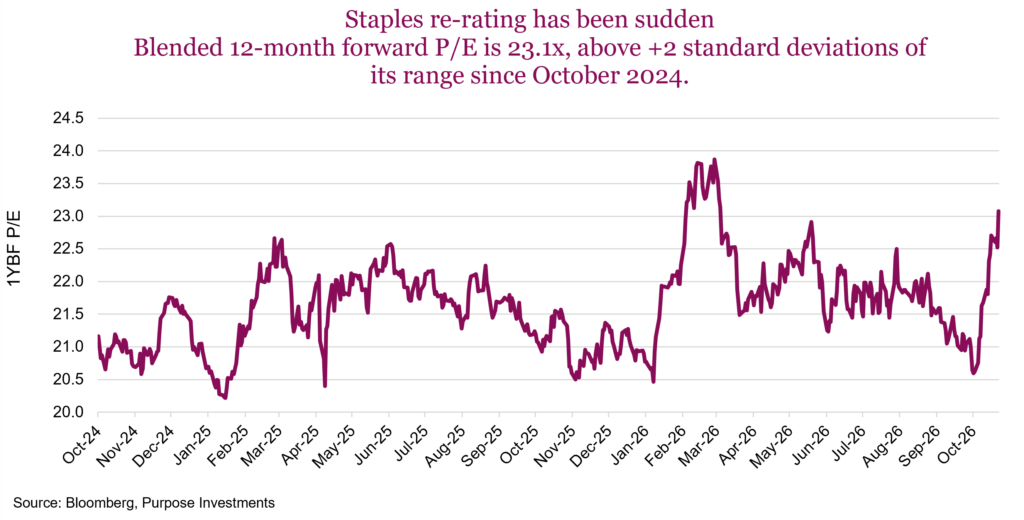
In the near term, valuations look stretched and some giveback wouldn’t be surprising. But what’s pushing money into these defensive segments of the market hasn’t gone away. AI expectations are still lofty, there appears to be rising scrutiny of capex, and the market is still extremely concentrated. One month does not make a trend, however from our perspective, the shift towards a more defensive mindedness still makes sense.
Final thoughts
There comes a point in any sports match, when the coach makes an obvious defensive substitution. It usually happens late, when the coach believes a more defensive-minded player gives the team a better chance of holding on to the win.
For our regular readers, this isn’t new, but it’s worth repeating: over the past few months, we’ve been making those substitutions. Markets have had another good year, with most indices up in the mid-teens year-to-date. We’ve been dialing back risk by moving to equal-weight US equities and adding bonds. In our equity mandates, we’ve tried to balance cyclical exposure with higher quality dividend payers. Staples and oversold rate-sensitive areas of the market are looking more constructive from a relative perspective and defensive positioning.
AI capex remains the near-term driver of the macro and overall macro-outlook, but returns on this massive investment remain the open question. Confidence surrounding these returns has become a little shaky. The winds have shifted and while we don’t know how long this will last, it’s a sign that market fragility has increased.