Market Ethos
10 February 2026
Mixed signals
Sign up here to receive the Market Ethos by email.
Last week, Anthropic launched an updated Claude AI model (Claude Cowork) focused on business solutions. The market quickly jumped to the conclusion this will disrupt not just software, but also a wide range of businesses from law to advertising. Given the fragility of market sentiment, it was a shoot-first-and-ask questions later reaction. Since reaching a new all-time high in late October, the S&P 500 software index is down -31%, with half of the drop occurring in the past couple weeks.
There is increasing numerical evidence that AI is starting to increase productivity, beyond just anecdotes. Anyone who has used Claude Code or other tools for coding is keenly aware of the increased speed of producing solutions (ourselves included). According to the Financial Times, there has been a 30% increase in code being pushed to GitHub, a large jump in iOS apps and a big jump in website registrations. All reasonable proxies for output and given no increase in tech jobs (a marginal decline actually), that probably means greater productivity.
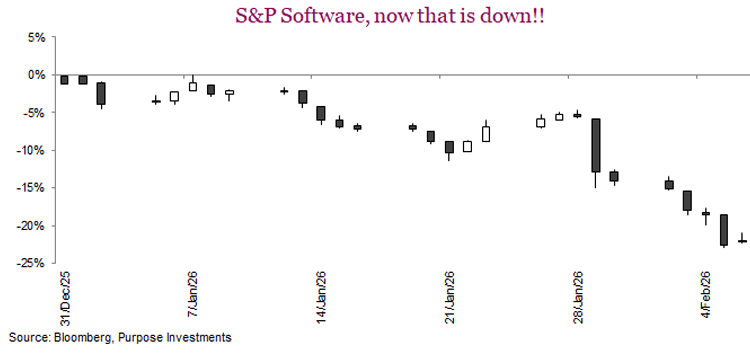
So, the market is saying Claude Cowork will do the same in other professions and this will either replace or cause a contraction in the number of software subscriptions (seats) required. Companies that sell seats for their software subscriptions have been hardest hit, even outside pure software. Thomson Reuters, which generates about half their earnings before interest, taxes, depreciation and amortization (EBTIDA) from services for lawyers, is down -30% over the past couple weeks. Factset, a financial research provider, down about the same. Workday, ServiceNow, credit rating agencies, the list goes on.
Maybe. Linear extrapolation of still-unquantified productivity gains in coding to other functions is a big leap. Developers often will spend 100% of their day coding; a Factset user is likely doing 20 or 30 different functions on a given day. So, extrapolation may be harder. Valuations also contributed to this bear market in software. Before the drop at 35x forward earnings, software was priced to perfection — now it’s at least a more reasonable 20x.
Markets often overreact in the short term. This could be the Deepseek moment for software. For those who forgot about Deepseek, the lower-cost, China-based large-language model (LLM) sent North American AI companies into a brief freefall that lasted a couple weeks. This is a big long-term risk for many software companies, but the reaction appears overdone. Software companies are very good at evolving and adapting, albeit it can be a very painful process. Even Thomson Reuters has CoCounsel, an AI- driven drafting and analysis tool.
Something is off
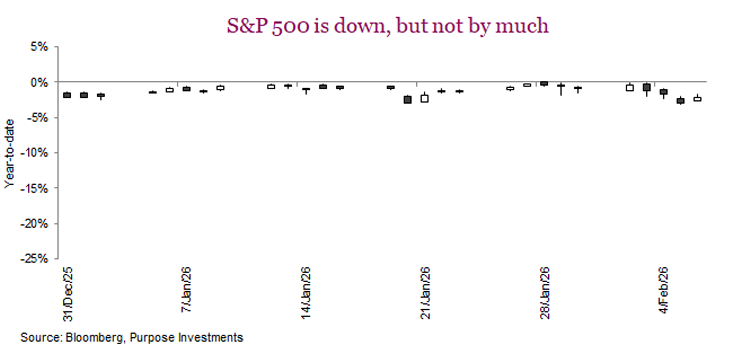
The size of this reaction in software is likely exacerbated by something being off in the markets that goes well beyond our good friend Claude. This may sound odd, but it has been reiterated by many, from market strategists to traders. We’re not being alarmist; the S&P is down about -2%, TSX a bit more down -4%, international equities barely down at all, but there are some strange things afoot.
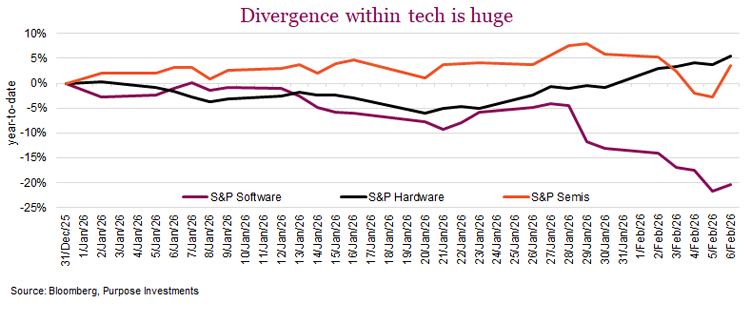
We have already discussed this dramatic drop in software stocks, but it is very isolated and has not spread to other parts of tech. The S&P hardware sector has barely moved and is now trending higher. Semis have been more volatile, but up as well. Maybe we can explain this if we attribute it all to AI models upgrades. It is very odd to see such divergence.
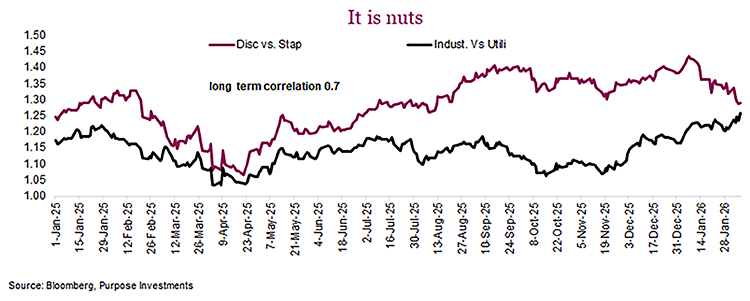
The list goes on. There has been a big rotation in the market so far in 2026, with defense winning. The best-performing sectors year-to-date are energy and consumer staples for the S&P 500, which is weird to begin with. Also very strange is our relative sector performance monitors (chart below). This is a risk-on/risk-off signal. In a risk-on market, consumer discretionary usually outperforms consumer staple while industrials outperform utilities. In a risk-off market, it’s the opposite. This means those lines should move up and down together, which they do over the long term. But recently the consumer-based model (purple) is showing risk-off while the industrial/utilities line is showing risk-on. Very odd.
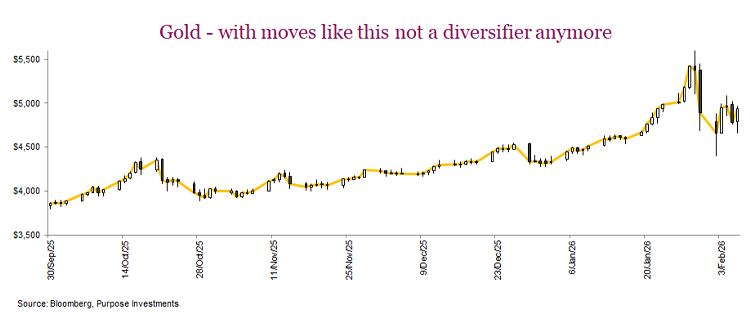
And if you still don’t think things are a bit off, let’s talk gold and bitcoin. Gold has changed from a crisis alpha portfolio diversifier to arguably a pure momentum play. $4,500 to $5,500 to $4,500 and now back to $5,000/oz is nuts. The drop in bitcoin as well.
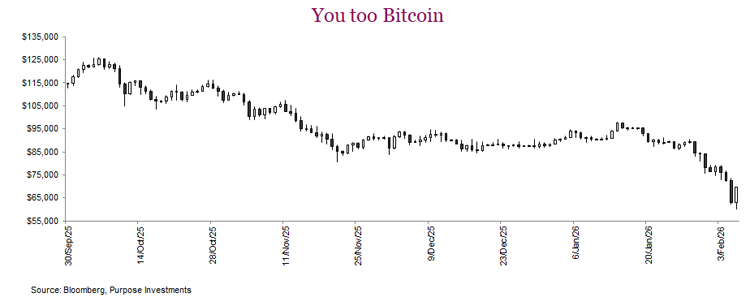
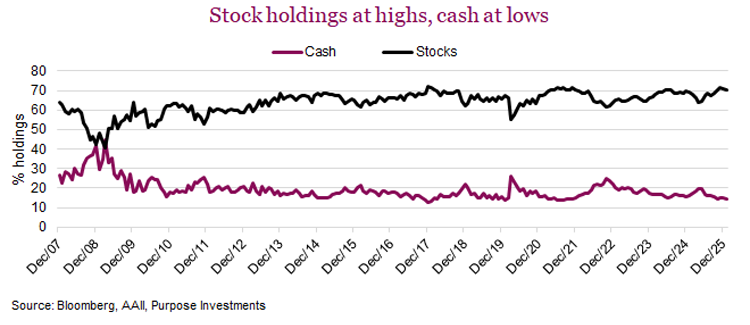
These kinds of strange market moves feel like some level of deleveraging could be occurring, maybe off the yen carry trade. This odd market could simply pass and calm down, or something might break. One challenge is that everyone is long the market, based on the American Association of Individual Investors. In their January monthly survey, cash is down to 14.4% and stocks up to 70%. Last time it was this extreme, it was at the end of 2017 and late in 2021. 2022 was the bear market as inflation took off and 2018 experienced two market corrections. Prior to that you have to go back to the end of the ‘90s tech bubble.
Final thoughts
The economy is good, earnings growth is good, inflation is fine, this is a good foundation. These are more market structure or market behaviour concerns. This is, or could, create some opportunities. Especially if there is an amplified misallocation due to deleveraging, or simply due to the large amount of fast money moving around in markets. Now, back to portfolio management.