
Market Ethos
17 August 2026
Benefits of going abroad
Sign up here to receive the Market Ethos by email.
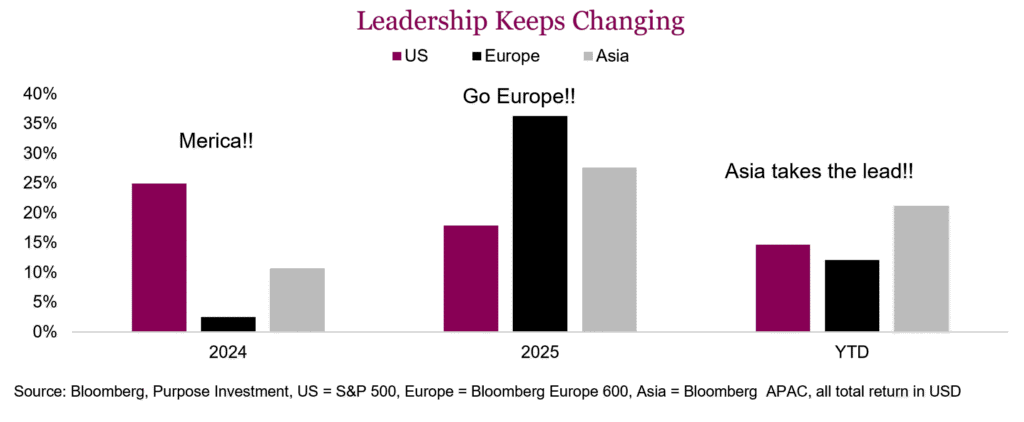
In 2024, America dominated global equities. In 2025 it was the opposite, with Europe the place to be. So far in 2026, global equities have all performed really well, with Asia in the lead. Obviously, these are pretty awesome returns, not just double digits but often north of 20%. Our readers are likely aware we that have had a positive affinity towards international developed markets for some time and a more neutral view on U.S. equities. This was not great in 2024 but since then it has been bang on, driving performance. But when it comes to investing, being right often leads to being wrong, while being wrong can lead to being right. The goal is to not ride your winners until they break down. And for those new contrarian positions, hopefully they don’t remain ‘wrong’ for too long.
So, is our positive view on international equities getting long in the tooth? Let’s start by sharing, updating and revisiting key points from our original rationale that made us more positive on international equities, and tested our conviction.
Valuations & earnings – At the start of 2025 U.S., equities were trading at 22x earnings which was about six points higher than their long-term median price-to-earnings ratio. Certainly, on the expensive side. Meanwhile Europe and Asia had valuations roughly in line with their long-term median levels of 13-14x — a clear advantage for international over U.S.
Fast forward to today and the valuation advantage does remain, but it is muted. The U.S. market is down to a more reasonable valuation of 20x, still expensive by a smaller amount. Meanwhile Europe is now 15.3x, which is higher than its historical median level. To confuse matters, Asia is down to 12.4x, a lower valuation than both median and at the start of 2025.
Valuations are nice to talk about but unless you factor in earnings growth, it only paints part of the picture. In 2025, the earnings growth differential between international and the U.S. narrowed significantly. In other words, after years of U.S. earnings growing much faster than international markets, the spread was much closer. Combined with cheap international valuations, this led to international outperformance. Today, looking at consensus earnings estimate over the next 12-months vs trailing 12-months, the pecking order is Japan #1 then the U.S. followed by Europe. Coincidentally, that matches with relative performance year-to-date.
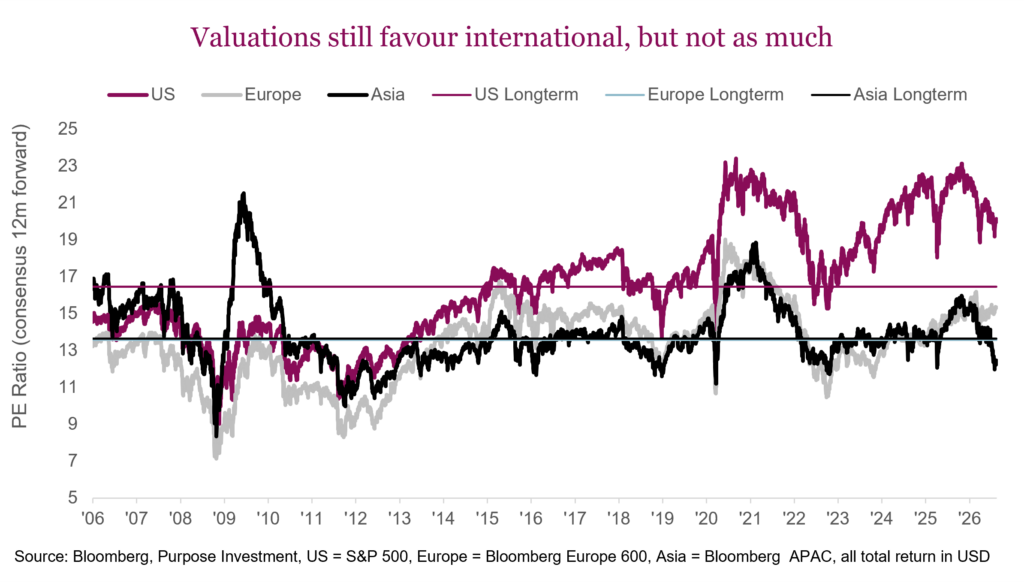
Add this all up, and valuations and earnings growth still favour Asia, and less so Europe. All relative to the U.S. which looks decent. This has us still favouring international from a valuation and earnings growth perspective, but just not as much as at the start of 2025.
Fiscal spending and governance – Following COVID, most countries reduced their deficits back to more ‘normal’ levels. However, the U.S. embarked on what we would call tactical fiscal spending. In other words, the U.S. kept the fiscal spending higher than normal to foster economic growth. Whether this was the right decision or not will only be known years down the road. In the meantime, it helped the U.S. economy grow faster than its more frugal peers.
Right or wrong, other countries are now increasing fiscal spending on categories such as defense and infrastructure. This has helped narrow the economic growth gap between these countries relative to the U.S. This is a positive on the international side.
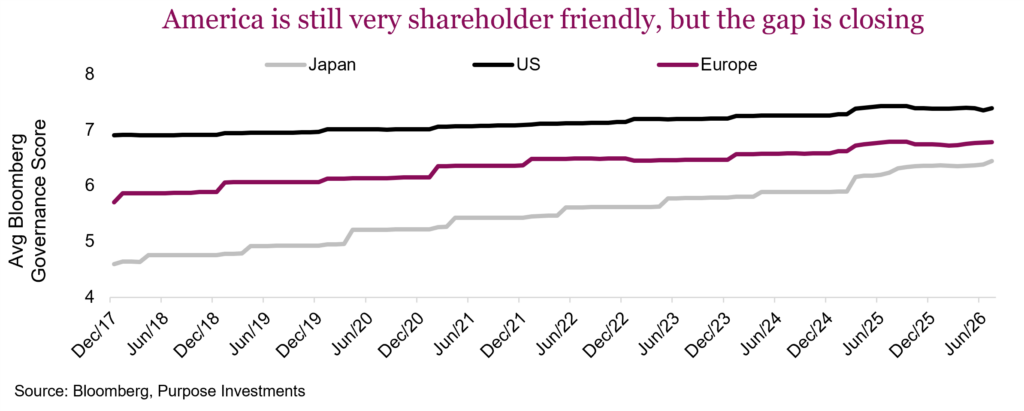
Governance has been improving as well. No denying America is very shareholder friendly. On the international side, we are seeing gradually improving corporate governance, implying companies are behaving in a more shareholder friendly manner than years past. This is helping translate into improving return on equity as well, a secular trend that is positive for international equities. Bit of a fixer-upper.
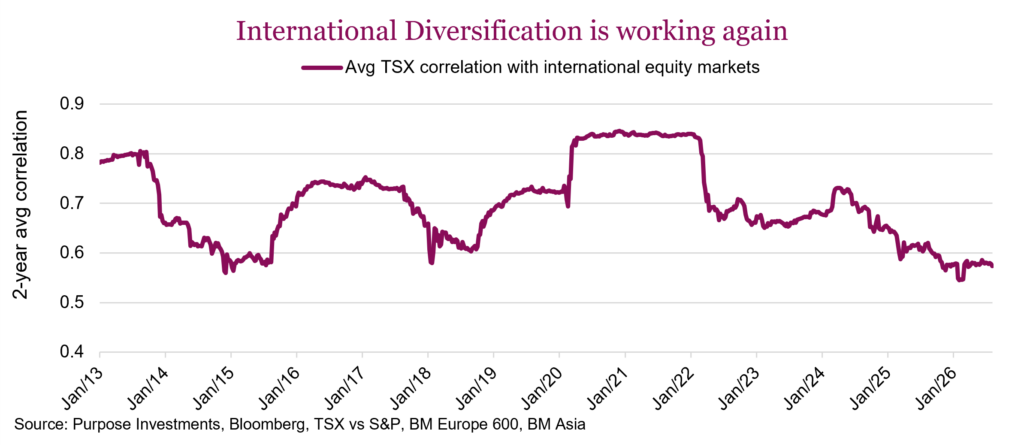
Diversification working again – Geographic diversification worked really well in the 1980s, 90s, and 00s. But in the 2010s, it certainly didn’t, given U.S. consistent outperformance and clustering of performance among international equity markets. More recently, the cross correlation between equity markets has been declining. This is a positive aspect of having more international from a portfolio construction perspective.
Another benefit is AI exposure. While we are bullish on this AI bubble, there is a risk to how it unfolds in the months or quarters ahead. Based on our AI exposure framework, the U.S. equity market is certainly heavily weighted to this rapidly advancing technology. International markets are less so. Japan has a lower exposure and is tilted more towards hardware. Europe has even less. This provides added diversification.
Trade & oil – The blockage of the Strait of Hormuz has certainly led to higher and volatile energy prices. This has been a negative for international markets compared to the U.S., mainly because of their relative energy reliance. While we do not know the future path of this conflict, our base case is it will be resolved from an energy flow perspective. Any move towards resolution has seen international equities rally more than U.S. And a more stable solution could easily usher in a period of stronger international equity performance.
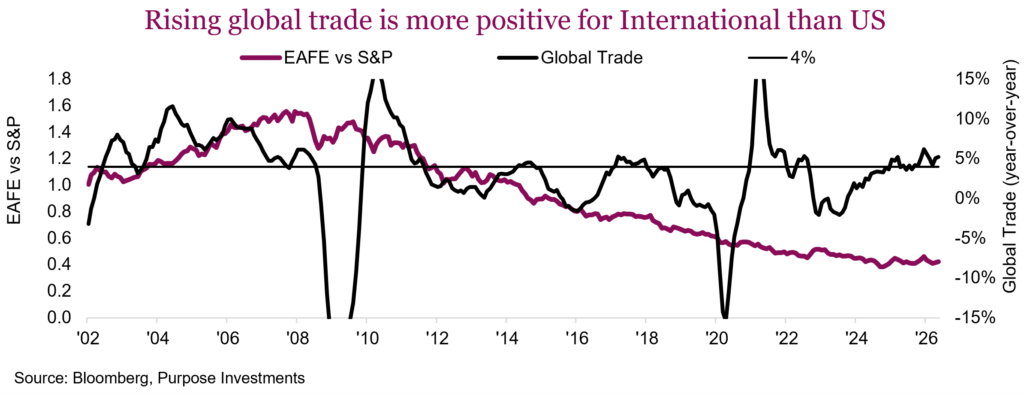
Additionally, global trade has been on the rise. As Europe and Asia are more sensitive to global trade, the more the better. Historically, periods of rising global trade, above the 4% line in the chart below, has coincided with international outperforming U.S. equities (EAFE vs S&P). We have now been over the 4% global trade growth threshold for a couple of years.
Final thoughts
It is not as cut and dry as it was in early 2025, but enough dynamics are in place to continue with a positive view on international equities. Valuation discount has narrowed but improving governance, rising return on equity, rising global trade and a potential cooling of energy markets remain supportive. Plus, with most portfolios still heavily U.S. tilted, there are strong diversification benefits from international which helps reduce portfolio AI exposure risks. Maybe not exceptional, but certainly worthy of healthy exposure.
Please don’t take this as a negative view on the U.S. We remain neutral or market weight to our baseline for U.S. equities, encouraged by strong earnings and valuations that are not as elevated. But we do remain more positive on markets across either ocean.