
Market Ethos
10 August 2026
When index flows meet insider liquidity
Sign up here to receive the Market Ethos by email.
Large IPOs can create unusual interactions between early shareholders, active investors and index-tracking vehicles. SpaceX provides a timely case study. Following its initial public offering in early June, the shares have experienced significant volatility as changes in free float have begun to influence index-related demand.
SpaceX IPO’ed with a really high valuation at about a $1.75 trillion market capitalization, the largest IPO in history. To put this in perspective, all Canadian equities total about $5 trillion. After the IPO, shares rocketed higher to breach just over $2.6 trillion and have since come back to earth with a current value of $1.4 trillion following reporting their first quarter as a public company. Clearly space travel is safer than this IPO.
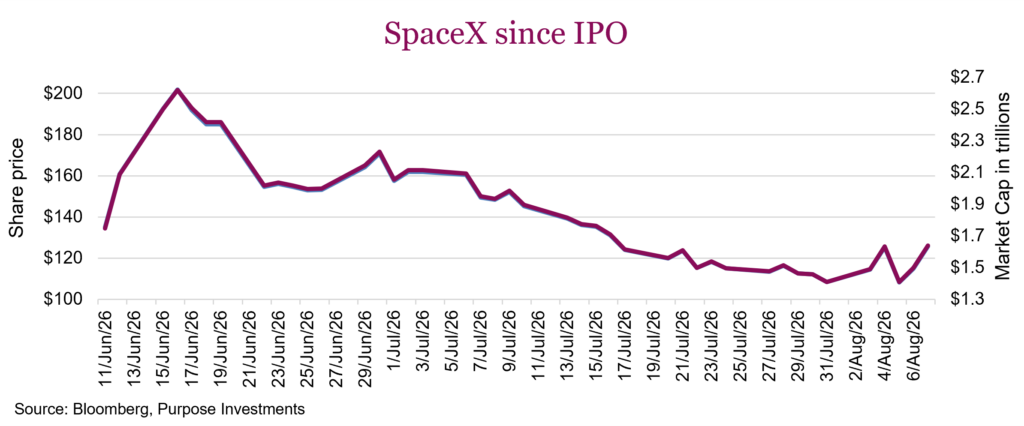
So why is this more than just a volatile IPO? It comes down to investor protection and market structure. For all IPOs, insiders or pre-existing shareholders often have lengthy lock-up periods after the IPO during which they cannot sell their shares. Sometimes these periods last quarters or years. SpaceX has what we would call a very aggressive schedule allowing insiders to sell. In fact, just about all insiders, apart from Elon Musk, are free trading by the end of 2026, a mere six months.
It goes roughly like this for pre-IPO shareholders: 20% release on Aug 6, two days after their Q2 earnings print. Then 7% every 2-4 weeks until Q3 earnings in October release the last 28%. This means we are just entering the period when insiders can begin selling. Pre-IPO shareholders include Alphabet, venture capital firms, sovereign wealth funds and employees.
On the other side are public-market buyers, including active investors and index-tracking funds. Elon Musk has a devoted retail following, but the more consequential market-structure issue involves index ETFs, popular and growing investment vehicles included in many retirement and savings accounts. These vehicles have become large enough to exert strong systematic effects on prices and markets.
Many indices altered their inclusion rules to enable them to add SpaceX more quickly after the IPO. It is a fair argument, as many companies are staying private longer and growing to gigantic size before tapping public markets. Nasdaq and FTSE Russell changed their rules, S&P Dow Jones didn’t. Perhaps with the S&P 500 outperforming just about every manager, why mess with that process.
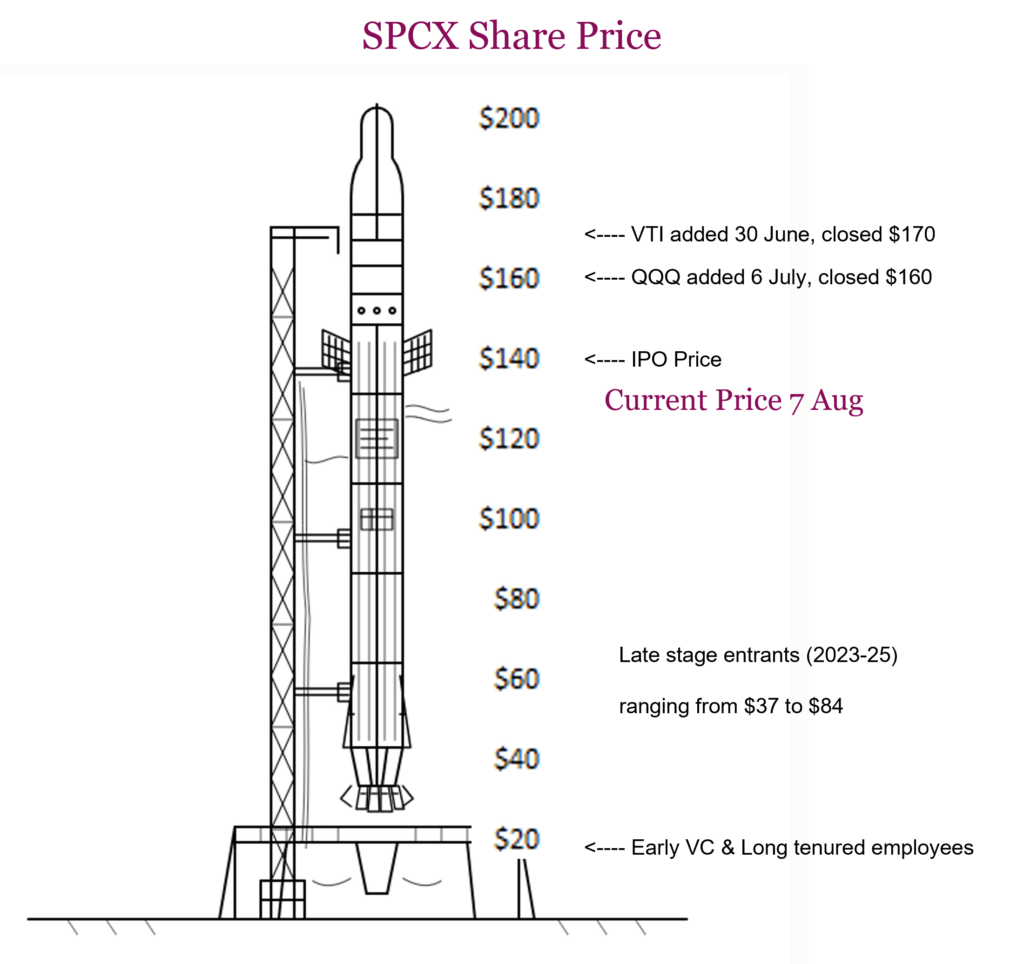
The key dynamic is that ETF weights are typically based on modified free float rather than total market capitalization. With most shares still held by insiders after the IPO, SpaceX initially carried a small index weight. As additional shares become freely tradable, its index weight can rise, prompting index-tracking funds to buy at the same time that pre-IPO shareholders gain the ability to sell. This creates a direct interaction between shareholder unlocks and systematic demand.
This is an interesting situation. We have many investors with extremely low cost bases, including early VCs. For those with costs in low single digits, they are likely happy sellers regardless of price whether $100, $150 or $200. Meanwhile, ETFs are buying as more shares enter the float, also regardless of price. Let’s say anything can happen. Insiders could wait and see if ETF buying pushes prices higher. There are an estimated 179 ETFs that now own SpaceX. Or the insiders could overwhelm buyers. One thing is certain, given the dynamics and size of this IPO, systematic flows are meaningful and provide lessons with other mega IPOs on the horizon.
Systematic flows matter
With more dollars invested via index tracking vehicles, systematic flows have become more impactful. Sure, fundamentals still matter, but investors should also be aware of flows. For instance, there was a good amount of weakness in other large holdings of major indices ahead of SpaceX inclusion. The 1% addition of SpaceX in QQQ for example, meant that all other positions were sold down by 1%. Across many other ETFs, this starts to add up.
These systematic flows can also create opportunities as they are temporary in nature. Will we see weakness across other holdings as more SpaceX become free trading, or as other mega IPOs are added to indices? Perhaps. But we would caution that it is never that easy, mainly because markets are made up of a lot of smart people who are also aware of these nuanced flows. Was the weakness in SpaceX heading into the August 6 unlock the result of investors front running this event? And now that it has passed, we are seeing SpaceX rebound strongly. Is this the ETF-buying bounce that will be met with supply as early investors look to exit?
Final thoughts
The broader lesson is not a view on SpaceX or any other individual security. It is that, as index-tracking strategies represent a larger share of equity-market ownership, changes in index eligibility, free float and constituent weights can generate meaningful flows. These effects may temporarily influence both newly added securities and existing index holdings. Understanding those mechanics can therefore complement, but not replace, fundamental and macroeconomic analysis.