
Investor Strategy
3 November 2026
Stickhandling the headwinds
Sign up here to receive the Investor Strategy by email.
- October tricks and treats
- Oscillating enthusiasm
- Rate of change calleth
- Market cycle
- Portfolio positioning
- Final thoughts
October tricks and treats
Equity markets experienced a shift in leadership in October as investors reassessed high valuations in the tech sector and the sustainability of AI capital spending. While economic conditions remained relatively resilient, concerns around the profitability of AI investments added to volatility among large tech companies. In the U.S., the S&P 500 declined 0.9%, while the Nasdaq fell by 5.3%, its worst monthly performance since March 2025. On the other hand, the Dow Jones gained 1.7%, as investors rotated towards more defensive sectors. Despite weakness in tech-related sectors, nine of the eleven S&P 500 sectors generated positive returns during the month, highlighting a broadening of market participation. Corporate earnings also remained somewhat resilient, with 82% reporting S&P 500 companies beating earnings expectations, although not by as much in previous quarters (more on this later) and blended Q3 earnings growth reaching 30.2% YoY. However, investors have become more and more focused on the huge capital expenditures required to support AI infrastructure, especially as spending pressures free cash flow and raises questions about future returns on invested capital. While demand for AI-related products and services remains strong, markets are becoming more selective in distinguishing between companies benefiting from AI adoption and those that are not.
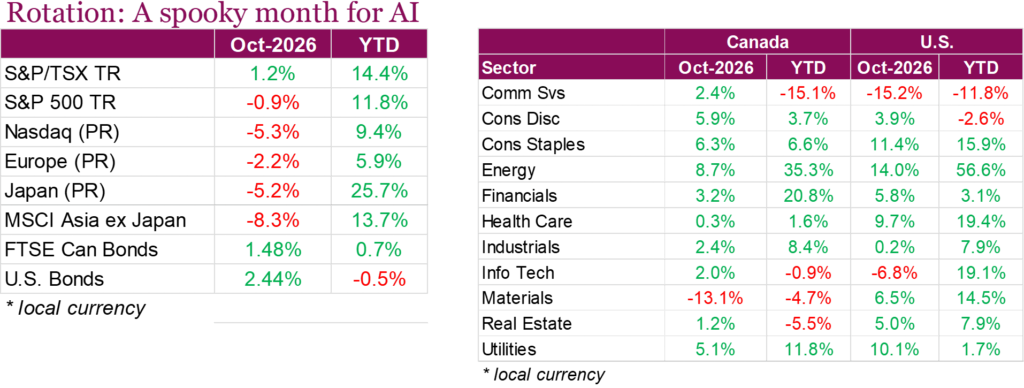
It was a different story in Canada, where Canadian equities outperformed their U.S. counterparts in October, with the TSX gaining 1.1%. Energy was the strongest contributor to index performance, while financials also provided support, although these gains were partially offset by weakness in materials, which was the largest detractor from overall index performance. On the economic front, Canadian inflation increased to 3.1% in September, mainly due to higher energy prices, as core inflation measures remained relatively contained. At the same time, the economy continued to show signs of softness, particularly in the labour market, where unemployment remained near 6.5%. Still, the Bank of Canada increased its policy rate by 25 bps to 2.50% in October, reflecting concerns that elevated energy prices could translate into broader inflation pressures. The Fed, meanwhile, maintained interest rates as policymakers continued to assess inflation risks and economic conditions.
Fixed-income markets experienced a recovery during the month as investors sought the relative safety of government bonds amid equity market volatility. The U.S. 10-year Treasury yield declined from a recent high 5.3% at the beginning of the month to 4.93%, while the Canadian 10-year government bond yield also fell. Declining yields help support fixed- income returns, with Canadian aggregate bonds gaining 1.48% and U.S. aggregate bonds advancing 2.14%.
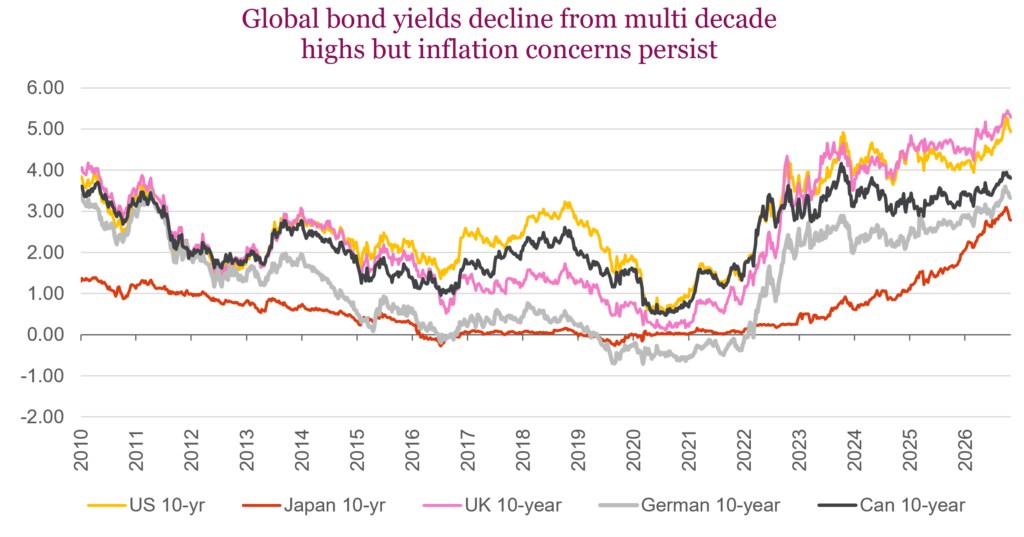
Outside North America, international markets continued to face a combination of economic and geopolitical challenges. In Europe, elevated energy costs contributed to renewed inflation pressures, while political and fiscal uncertainty (particularly in France), weighed on investor sentiment. The ECB maintained interest rates in October as policymakers balanced inflation concerns against the potential impact of tighter financial conditions. In Asia, Chinese equities remained under pressure as weak domestic consumption, limited fiscal stimulus, and declining enthusiasm for tech-related investments weighed on performance.
Looking ahead, corporate earnings, monetary policy, and geopolitical developments will remain important drivers for markets. Ongoing conflict in the Middle East remains one of the largest risks to inflation and economic growth, while the sustainability of AI-related spending will continue to be an important consideration for equity valuations. Still, many see the broadening of market participation beyond a handful of technology companies as an encouraging sign.
Oscillating enthusiasm
For all the headwinds and now some wobbling in AI enthusiasm, markets have been sitting in a tight range since the mid-summer rally on the back of incredible Q2 earnings (July/Aug). More on Q3 earnings shortly. Spoiler: it is not so incredible. While the chart may imply almost tranquil markets, that is certainly not the case. In that rectangular box that is about 3-months in duration, there were a number of rotations. AI enthusiasm rose in the late summer, but higher bond yields held other parts of the market back, including gold that weighs heavily on the TSX. Then AI excitement cooled a bit and the defensives rallied hard, with bond yields coming back down lifting interest rate sensitives.
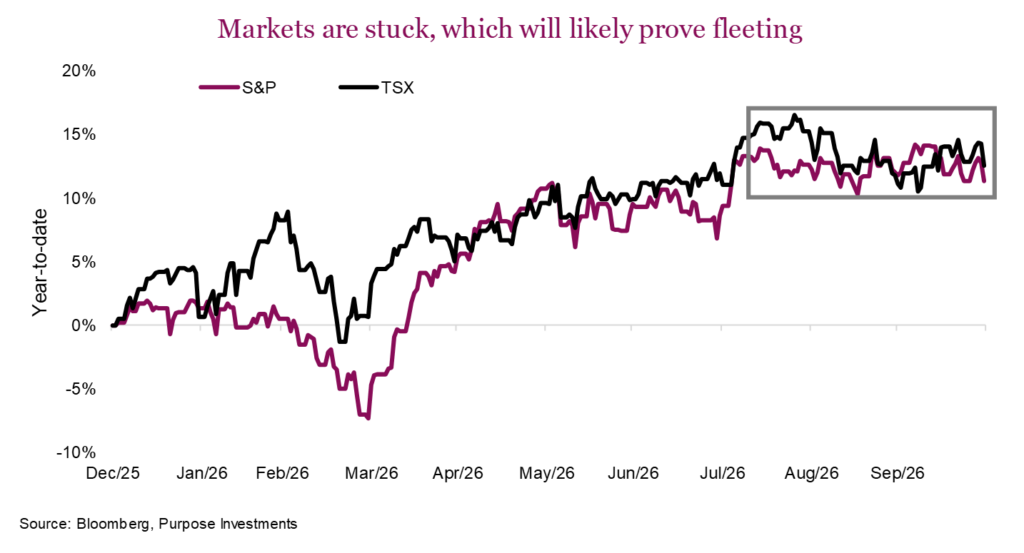
We continue to believe AI exposure has become so prevalent across many equity markets and economies that, as AI enthusiasm goes, so go markets and perhaps even the economy. That is not necessarily a bad thing as the spending is real and will continue given rising demand for this awesome technology. We have our doubts about the return on investment for this capex but that reckoning is likely pretty far down field. In the meantime, we will likely experience oscillating periods of enthusiasm, causing markets to oscillate as well. It has already started.
To measure the magnitude of this enthusiasm, we turn to markets as an intuitive shortcut. Based on our AI detection tool for measuring portfolio or index AI exposure, we can say with confidence the NASDAQ 100 is very heavy AI while the S&P 500 equal weight is not. Tracking the relative performance of these two indices provides a good measure of oscillating AI enthusiasm.
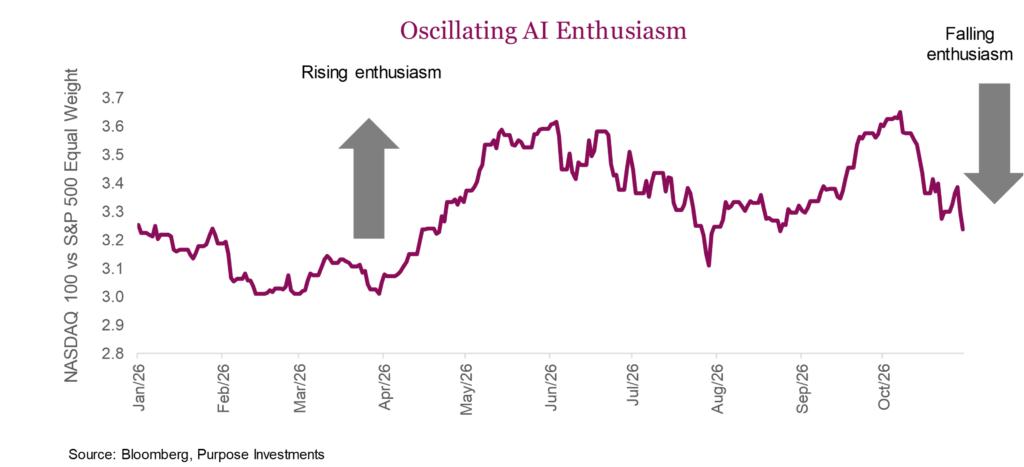
We do believe this AI bubble will persist for some time, however we also believe we have entered into the oscillating phase that will see bigger swings in both directions. As of late, we are in a falling enthusiasm phase with a mega IPO on deck and rising concerns over returns on investment. In our view, one thing is for certain: the buy and hold phase is likely behind us requiring a more nuanced approach.
Rate of change calleth
The global economy is growing nicely, even with a few headwinds. Global earnings are growing too. Bond yields have even come back down a smidge, as have equity valuations. All pretty constructive characteristics, as we head into a historically seasonally strong period for markets. Unfortunately, this market may become a victim of its own success.
On January 1, global equity earnings were expected to grow by 12% in 2026. Those estimates proved woefully too conservative. Blockbuster earnings seasons for Q1 and Q2 lifted calendar year estimates to reflect a whopping 32% annual growth in earnings. 12 to 32 is quite the revision. In fact, equity gains this year were largely accomplished during those Q1 & Q2 blockbuster earnings seasons reporting periods.
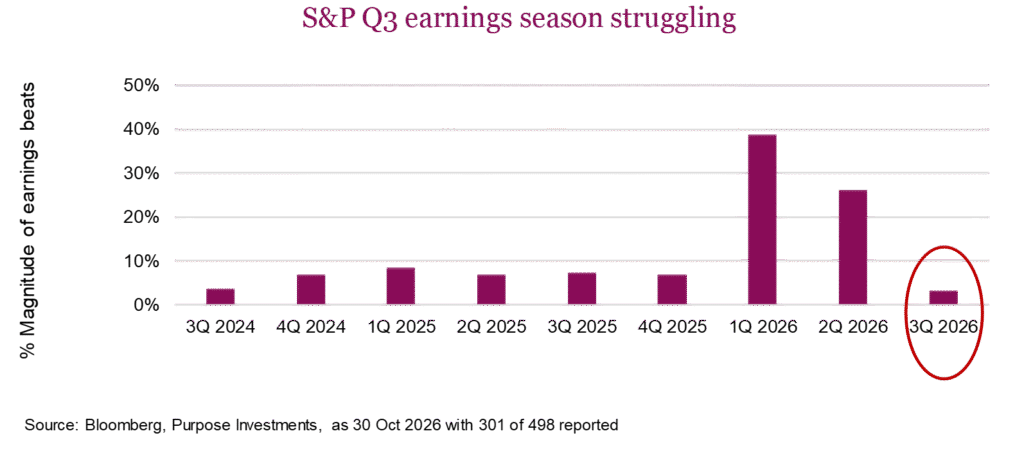
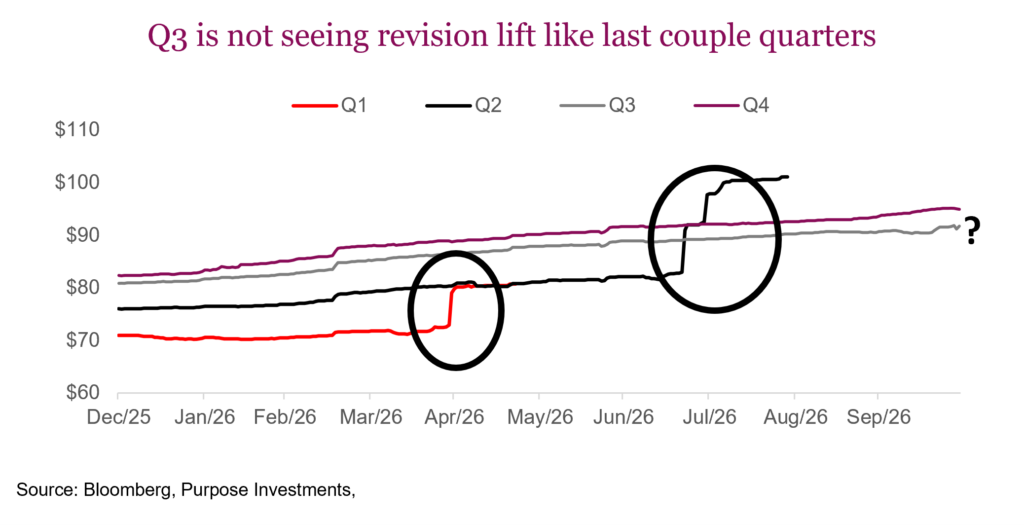
But now we are just past halfway through Q3 earnings, and it is a bit troubling. Earnings are still surprising, still growing, but the pace has certainly decelerated. For the S&P, 301 companies have reported with the magnitude of earnings beats falling to a mere 2.9%. For some context, the earnings beats were 39% and 26% in the previous two earnings seasons. Perhaps the easiest way to contrast this current earning season with the last two is in the chart below, which captures the upward revisions during earnings seasons. Q1 and Q2 earnings crushed estimates and revisions flowed. So far, this is very muted for Q3.
Maybe this will turn around in the next week or so. Even so, it is likely the rate of change is set to slow. We may still be encouraged by the positive growth, however markets often react more to changes in rate of change compared to absolute levels. This isn’t a surprise; nobody expects the 30% earnings growth pace to continue. But slowing fundamentals is a challenge for markets to push higher and perhaps explains why we have been stuck in the range over the past few months.
Market cycle
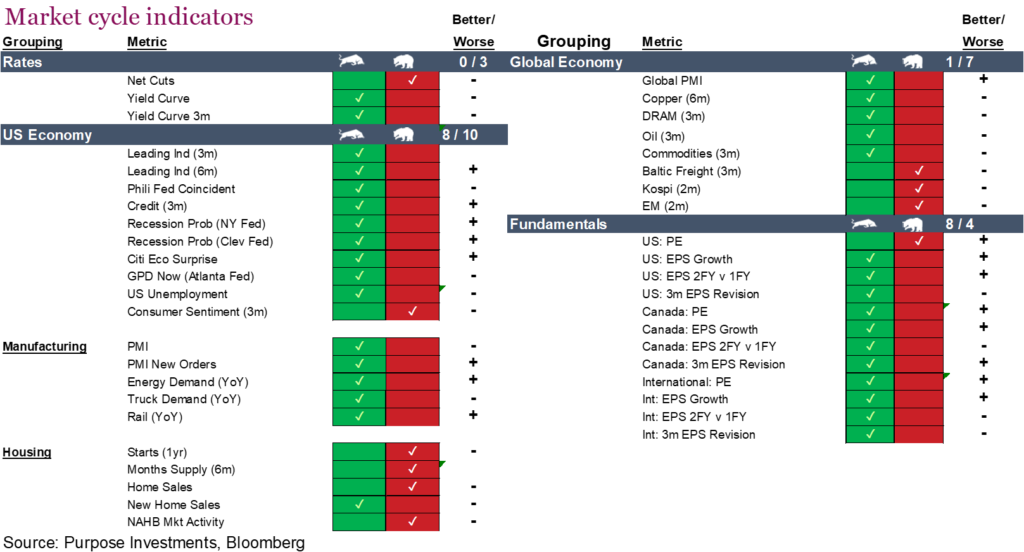
While earnings may be finding it hard to keep the pace of past success, the global economy remains in good shape. Our market cycle indicators largely remain in the bullish camp, with a little improvement on the U.S. side and a little softening globally. For the first time in a long time, leading indicators have turned up in the U.S. Plus, all indicators for manufacturing are encouraging as the global improvement in this category remains on track. The soft patch of course is housing, which is not news. Capex focused on data centres doesn’t really care that much about the level of interest rates; the housing industry still does.
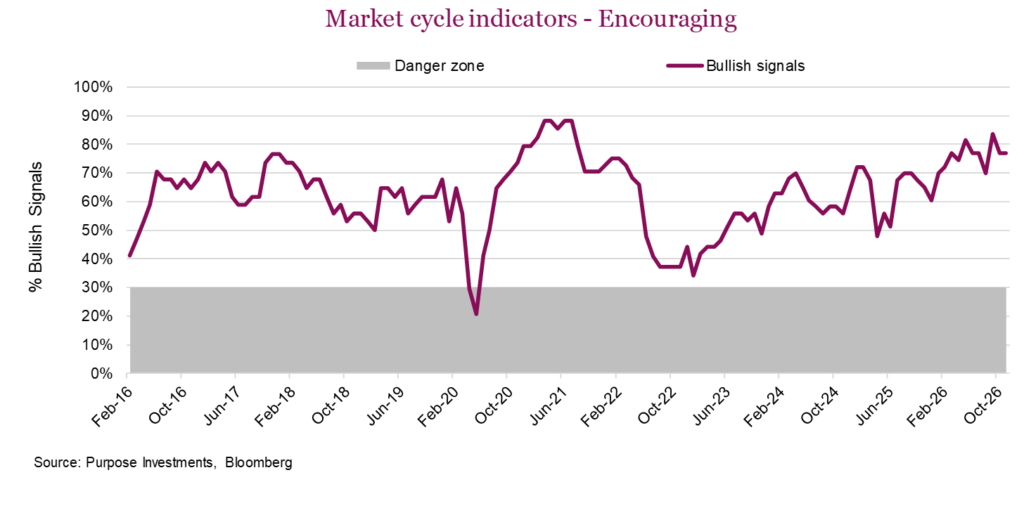
Overall though, still an encouraging foundation. That doesn’t rule out a corrective phase; as AI enthusiasm oscillates, so will markets. As long as the economic data holds up, weakness should be viewed as a potential opportunity.
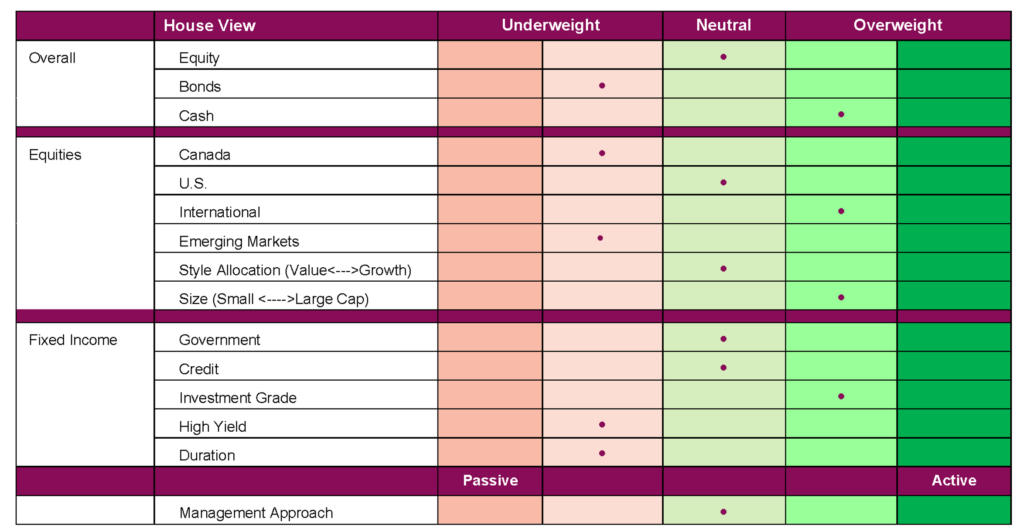
No changes to our portfolio positioning of late. We are underweight on bonds, while we remain neutral on equities and holding more cash. We maintain neutral to slight underweight on U.S. equities with a larger underweight in Canada. Our overweight remains focused on international developed.
Portfolio positioning
Final thoughts
November and December are often positive months, more often than the average. However, markets are still up a good amount this year, pricing in a lot of positive news. Who knows how the market reacts to the midterms or any change in hostilities with Iran or the pending Treasury funding announcement. All could surprise markets in either direction. But we do know the fundamental follow-through from Q3 earnings is uninspiring. This may prove to be a challenging couple of months. We remain defensive with an eye to be opportunistic should a correction develop. It has been a wild year already; this is likely to continue.