
Investor Strategy
5 August 2026
Extra time
Sign up here to receive the Investor Strategy by email.
- No summer doldrums
- Sometimes good isn’t good enough
- All that glitters
- Market cycle & portfolio positioning
- Final thoughts
No summer doldrums
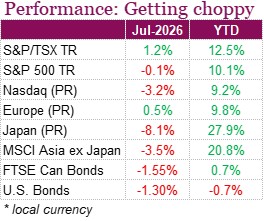
Equity markets lost some momentum in July following a strong first half of the year, with performance diverging across regions and sectors. The TSX gained 1.2% on a total return basis, helped by strength in the energy sector following renewed hostilities in the Middle East, while U.S. equities weakened with the S&P 500 finishing the month nearly unchanged and the Nasdaq declining -3.2%. Much of the market’s attention centered on technology shares, particularly semiconductors, as investors reassessed whether the rapid pace of AI-related capital spending can be sustained. The Philadelphia Semiconductor Index recorded its largest monthly decline since the 2008 financial crisis, reflecting concerns over future big-tech investment, rising competition, and the introduction of more efficient open-source AI models. Despite the selloff, strong earnings from companies such as Amazon and Microsoft reaffirmed near-term AI investment plans, while continued inflows into semiconductor-focused ETFs suggest many investors view the pullback as a long-term buying opportunity.
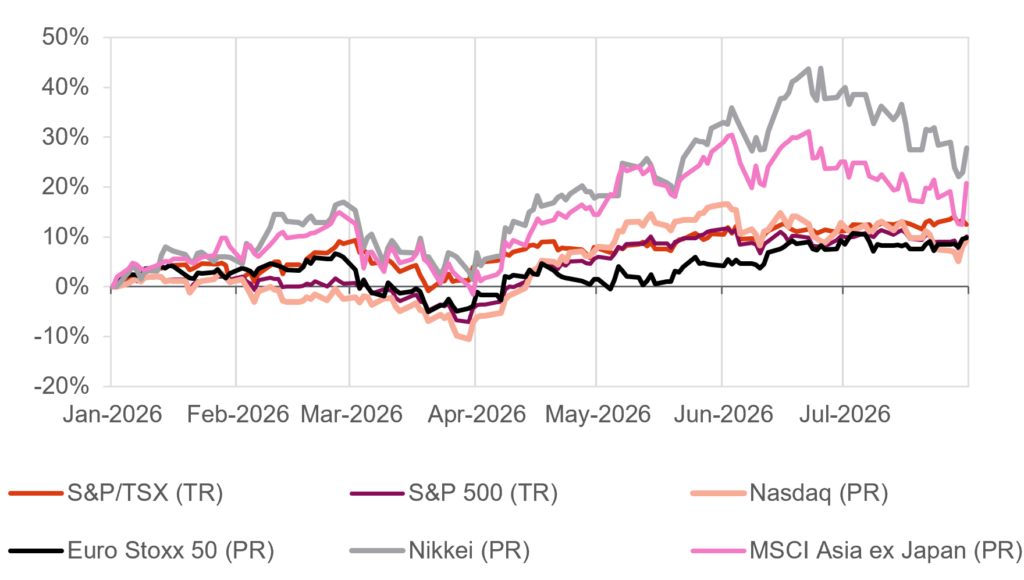
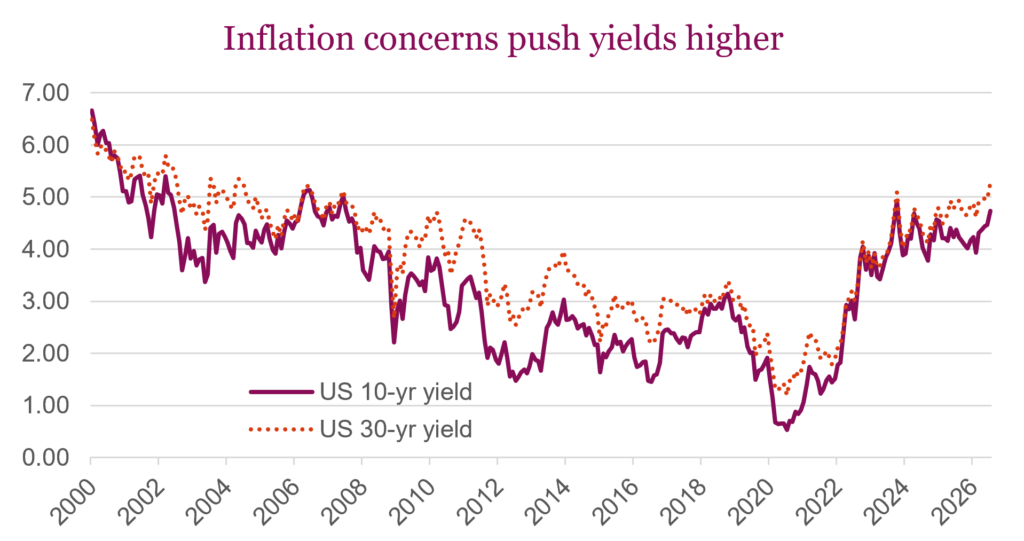
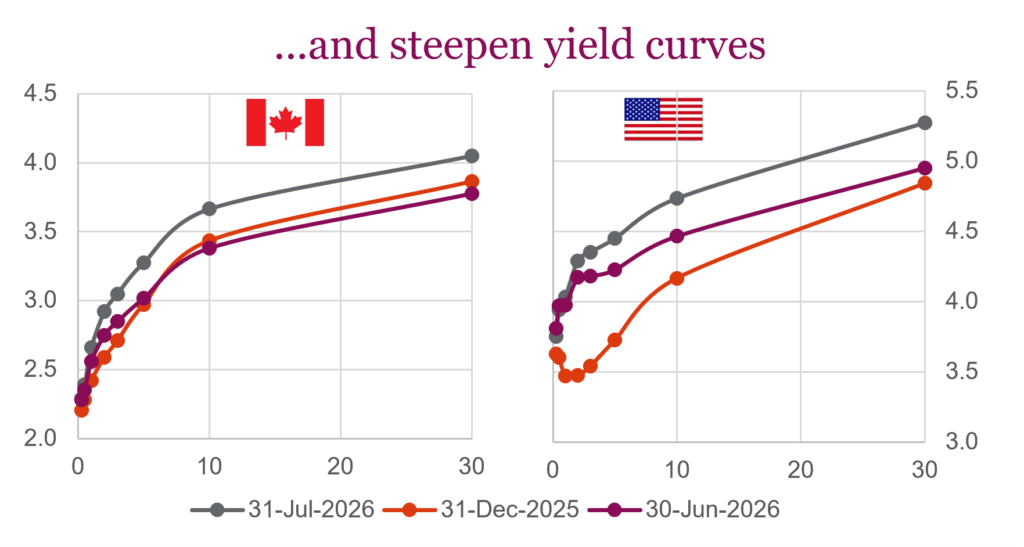
Central banks also remained in focus as policymakers balanced resilient economic growth against persistent inflation pressures. The Fed left its benchmark interest rate unchanged at 3.50%–3.75%, although a 9-3 split vote highlighted concern among some policymakers that inflation may require additional tightening. The Bank of Canada also held its policy rate at 2.25% for a sixth consecutive meeting, maintaining that the current setting remains appropriate as inflation pressures ease despite global uncertainty. While the central bank acknowledged stronger second-quarter growth and improved longer-term economic forecasts, it stressed that risks tied to tariffs, geopolitical tensions, and inflation remain elevated, reinforcing a cautious, data-dependent approach. The U.S. Treasury yield curve steepened during the month following the Fed’s decision to leave interest rates unchanged. The resulting steepening reflected growing uncertainty over the Fed’s inflation-fighting credibility and contributed to weakness across long-duration fixed income, while the Canadian yield curve also steepened, though to a lesser extent. The move weighed on longer-duration bonds and contributed to negative returns for both Canadian and U.S. Aggregate bonds, with the U.S. Aggregate Bond Index declining -1.30% and the FTSE TMX Universe Bond Index falling -1.55% during the month.
Despite heightened volatility in tech and a cautious monetary policy backdrop, corporate fundamentals remained strong. With approximately 61% of S&P 500 companies reporting second-quarter results, 87% exceeded earnings expectations and 77% surpassed revenue estimates, putting the index on track for year-over-year earnings growth of 47.4%, the strongest since 2021. Positive earnings guidance has also outpaced negative guidance for the third quarter, delivering confidence that corporate profitability remains resilient. More on this and a deeper dive into earnings shortly. Looking ahead, investors will continue to monitor the sustainability of AI-related investment, the trajectory of inflation and interest rates, and whether strong earnings growth can continue to support equity markets through the second half of the year.
Sometimes good isn’t good enough
As we pass the halfway point of the S&P 500 Q2 earnings season, summing it up so far in one word – awesome!! 87% of companies have exceeded consensus analyst estimates (as of July 30). Positive surprises are the norm, but this is certainly strongly on the high side. Even more impressive, S&P 500 Q2 earnings estimates were $82 at the start of reporting season, and they have already jumped to $98 — that is 46% higher than Q2 of 2025. Even better, it’s broad-based, as so far at least, every sector is enjoying positive aggregate surprises. So, it is not just energy (thanks to high oil prices) or tech (thanks to AI data center spending). Just the right amount of inflation to help topline growth, solid economy, AI spending and a consumer hanging in, driving these awesome results.
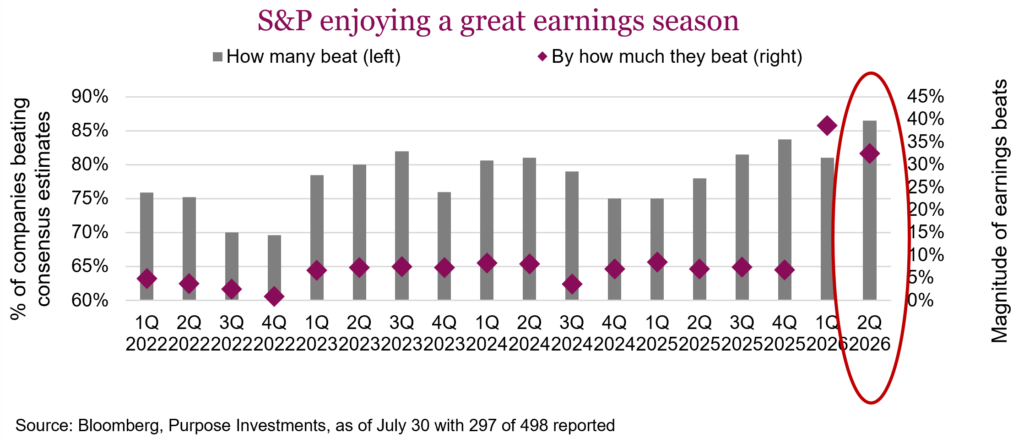
Unfortunately, share prices are not reacting as enthusiastically across the board. In fact, there is a significant divergence in price reaction. Information technology and communication services are seeing sizeable earnings beats, but the share prices are moving lower on the news. Part of this reaction is likely from expectations being much higher than consensus estimates, the so-called ‘whisper number’. But it is more likely driven by a cooling of enthusiasm around the AI buildout. A few quarters ago the market would react positively to news of a hyperscaler increasing capex, now not so much. Add in rising risks from China’s ‘lower cost’ AI models, and the need to show a positive return on investment is building quickly at the moment. We continue to believe the market’s enthusiasm for AI will ebb and flow for many quarters – currently it is clearly flowing.
Conversely, the price reaction in other sectors is very strong. Consumer staples, health care, energy and real estate are seeing prices jump higher on earnings. Unfortunately, those sectors carry a combined weight in the S&P 500 of about 20%, much less than the 46% in tech and comm services. As a result, the broader market level is struggling despite an earnings season that is filled with a lot of good news.
Suppose we could celebrate this as a rotational change from growth to value, or from the momentum factor to the dividend factor, or from market cap weight to equal weight. But it is none of those things; this looks to be an AI correction. Looking at sectors with higher AI exposure at the company level, they are reacting to earnings to the downside while those sectors with lower AI exposure are doing well.
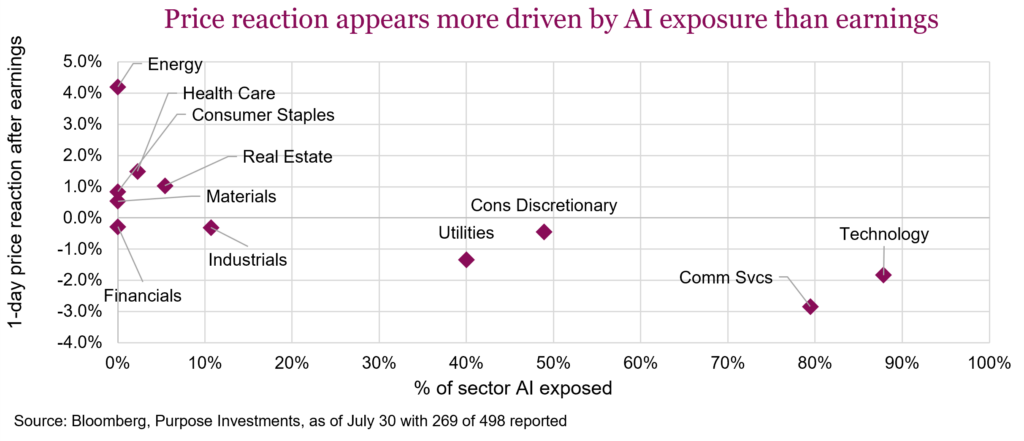
For better or worse, this market is now driven by variances in AI enthusiasm. If this bubble has many more quarters to run, that is fantastic news. If the enthusiasm wanes, there is a lot of downside. Our stance: you want some exposure, but it should be tempered. The argument we are in the early innings of share price reaction is pretty weak given the amazing gains already achieved and acknowledging everyone is aware of this technology advancement. More likely we are somewhere near the second hydration break. But extra time is always a possibility.
All that glitters
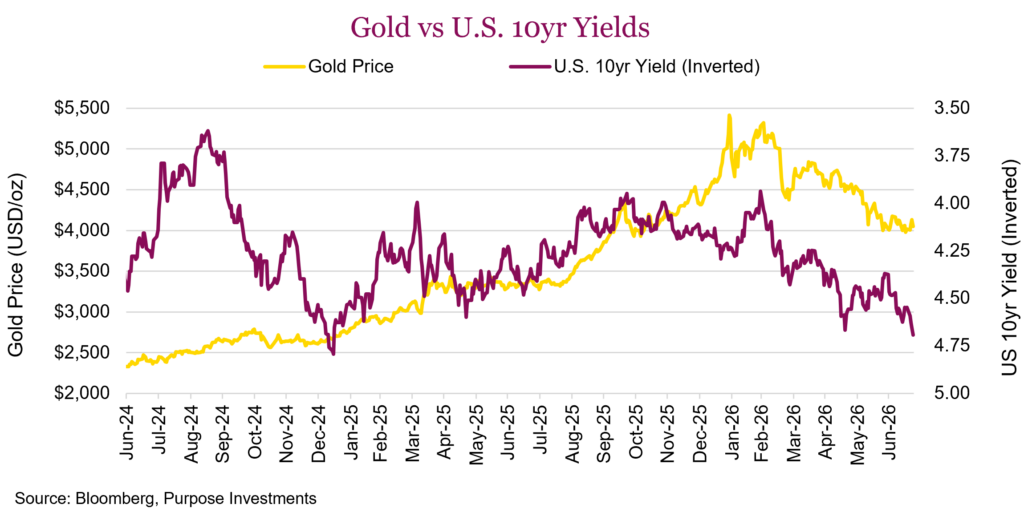
When the Iran conflict broke out at the end of February, and the Strait of Hormuz was effectively choked off, this was supposed to be gold’s moment. Instead, all that has glittered since is anything but: markets are up, oil stocks surged, even the Canadian banks are up 25% since then. Gold was already up over 20% YTD at that point and over 80% in a year. Maybe it didn’t perform exactly as expected, then again, what did we really need safety from? Whatever the market was worried about, it got over it quickly, and gold was left behind, entering a bear market down over -25%. The miners have fared even worse, with the TSX Global Gold Index down -33% as we write, just a little off the recent lows.
Anatomy of a golden bear – From a contrarian lens, it’s an interesting setup. Call it digestion after an incredible 140%-plus return for the miners last year and over a 50% gain for bullion. Heck, after all that, miners are now merely performing in line with oil stocks over the past twelve months. The froth has been taken out of the market. Gold has been trading much more in line with rates recently as seen in the chart below, but the drawdown has multiple factors: rising yields, both real and nominal, a rising U.S. dollar, and a metal that was simply overbought after a sensational rally. A pullback was due but there has been little change in the fundamentals or the structural reasons behind the gold bull market of the past number of years. More recently there have been certain shifts in the market. Gold hasn’t made a new low since late June, carving out a potential double bottom even as yields ground higher, oil spiked again and the dollar stayed firm. Bad news that stops pushing prices down is no longer bad news. With yields nearing the range where they have typically rolled over, and bearish positioning at elevated levels, we view the risk/reward of owning the shiny yellow metal as positive once again.
One consistent buyer – Commodities trade on supply and demand, and for gold the main character of the demand story has been central banks. That structural demand did slow last year, and cracks formed in the thesis during the outbreak of the war, as some smaller central banks were basically forced to sell gold reserves for a variety of funding reasons. A significant data revision slashed estimated first-quarter purchases from 244 tonnes to just 57 tonnes, the lowest first quarter in more than 15 years, with the central banks of Turkey, Russia and Azerbaijan leading the selloffs and several Middle East sovereign funds also selling to offset conflict-driven declines in oil and gas revenues. All told, first-half net purchases of 346 tonnes were the lowest in four years.
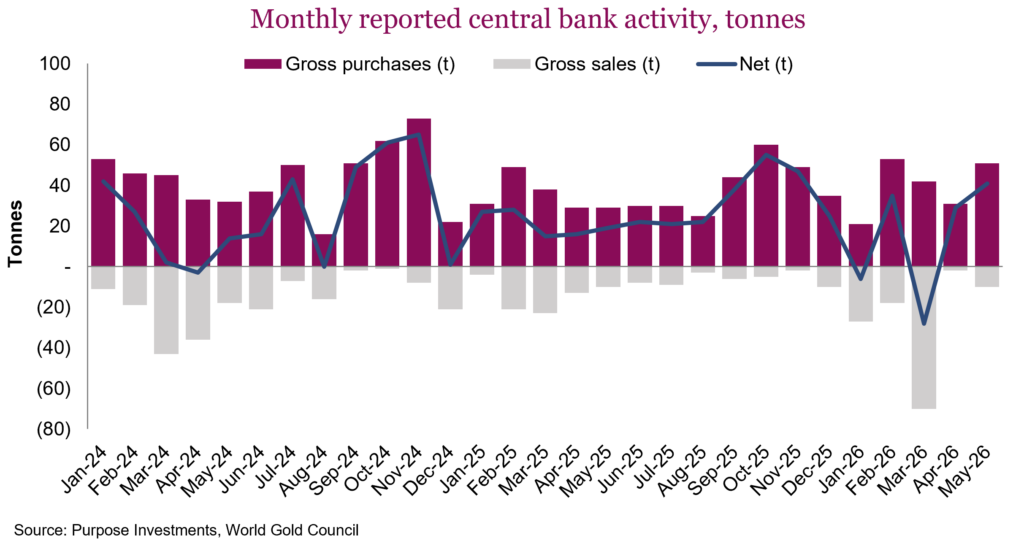
Those fears didn’t survive the second quarter as central banks bought a record 289 tonnes of gold, a 74% annual increase, with the geopolitical uncertainty strengthening the case for bullion as a reserve asset. China has ramped up its buying in recent months, seeing its largest quarterly increase since 2023. From our point of view, the central pillar of the demand story remains intact. The selling pressure has abated, and central banks continue to have a strategic case to buy gold, diversifying reserves to protect against uncertainty in geopolitics and financial markets. That should help provide a floor for gold prices.
Gold in the portfolio – From a portfolio standpoint, we’ve long been proponents of owning at least some gold. Crisis alpha is a term we’ve embraced as a rationale. Gold was easy to own when it was a top-performing asset class, less so when it’s been a drag over the past few months. We view it as a solid diversifier, with both inflation protection and risk-off benefits. The producers are doing well, still generating great free cash flow, growing dividends and buybacks on top of modest but rising dividend yields for many. Judging by recent sell-side notes, inbounds from generalists have already picked up.
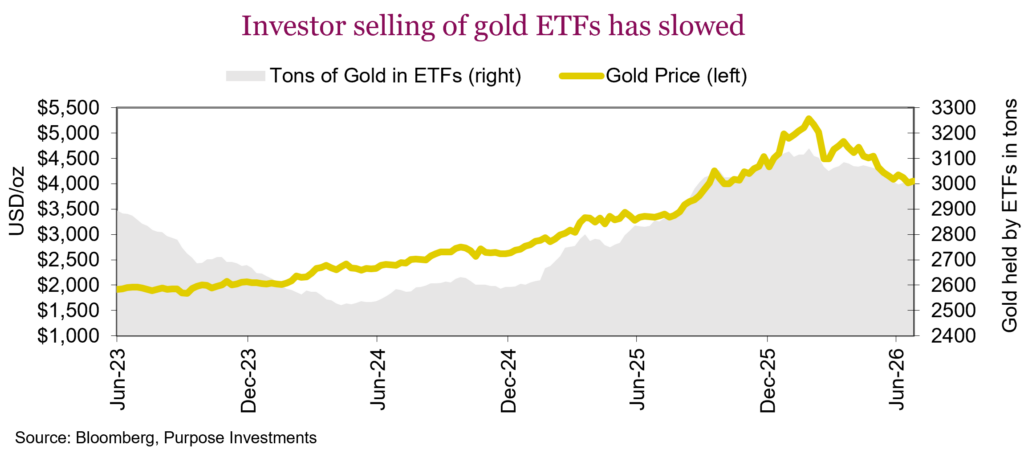
The ETF headwind is fading too: outflows from gold-backed ETFs during the second quarter appear to have slowed, and we’ve actually seen a slight uptick in tonnes held. Too soon to get excited about a slight uptick, but again, the bad news is subsiding. The recent pullback to around $4,000 oz may be a good entry point for those who are looking to add some gold, and this price level may provide a reasonable level of support for a second half rebound in gold prices.
Market cycle
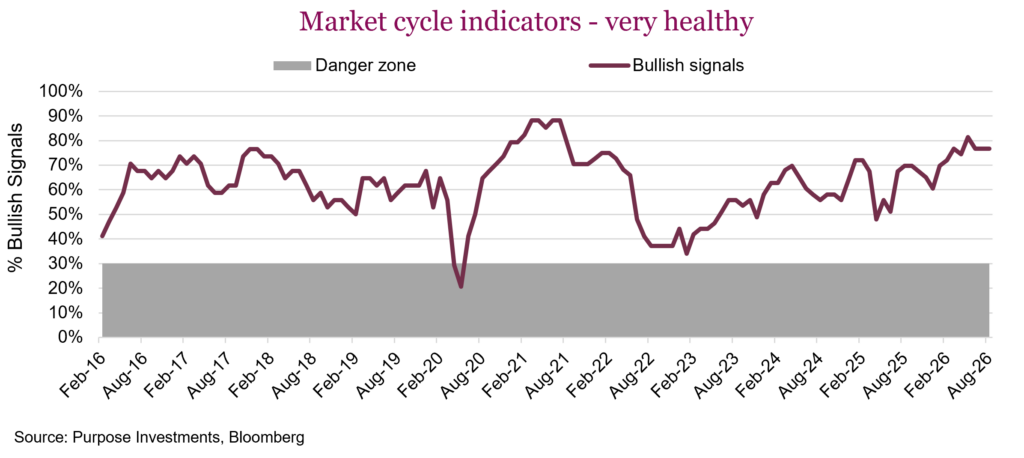
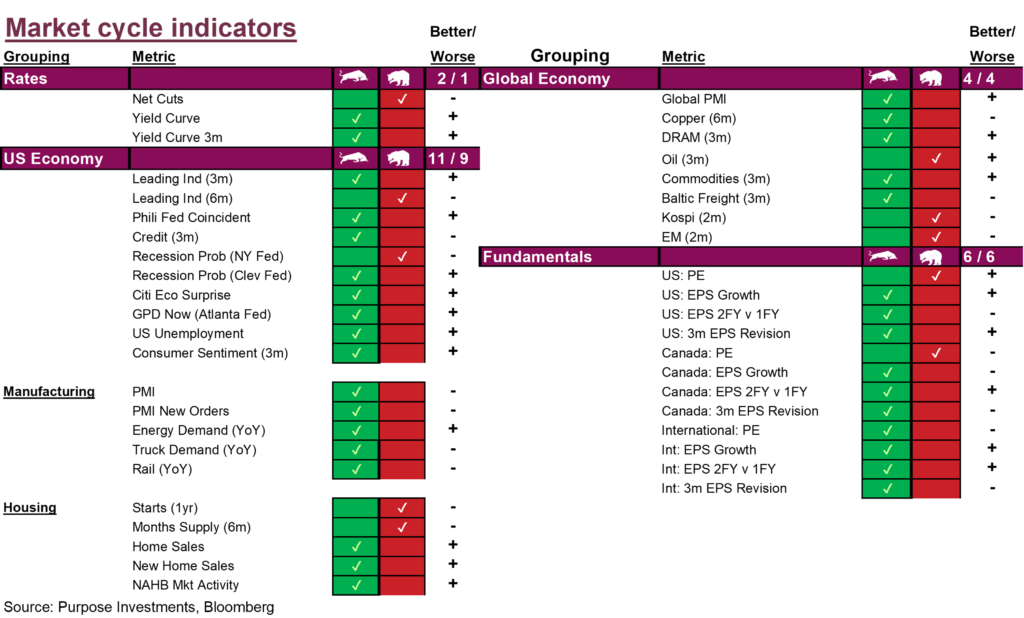
While the equity markets are currently more influenced by variances in AI enthusiasm, the foundation is pretty solid. Market cycle indicators remain very healthy. Yield curve steepness is positive. The U.S. economic data is good. Leading indicators still bearish longer term but may be starting to turn up a bit. Surprise rates, GDP Now, employment and even sentiment appears to be stabilizing, albeit at low levels.
This framework has seven U.S. consumer indicators: S&P 500 performance, Leading Indicators 1-year change, Bank Lending Standards, Sentiment survey, Jobless Claims, Home Prices and Oil Prices. A bit of a concern, only three of the seven are bullish including S&P, Jobless Claims and Home Prices. Lending Standards are only mildly bearish. A month ago, four were bullish, so there has been some deterioration.
Q2 U.S. GDP showed some strong consumer spending, but so far in Q3 we have seen card data pointing to softening spending. For now, we are not concerned, and the market clearly doesn’t care either. But if the card spending continues to soften and/or more indicators flip from bullish to bearish, our concern will grow. Very data dependent, so stay tuned.
Global economy indicators are still decent, given that two bearish signals are the KOSPI and emerging markets performance, currently tied up in the AI theme. More fundamental data remains healthy.
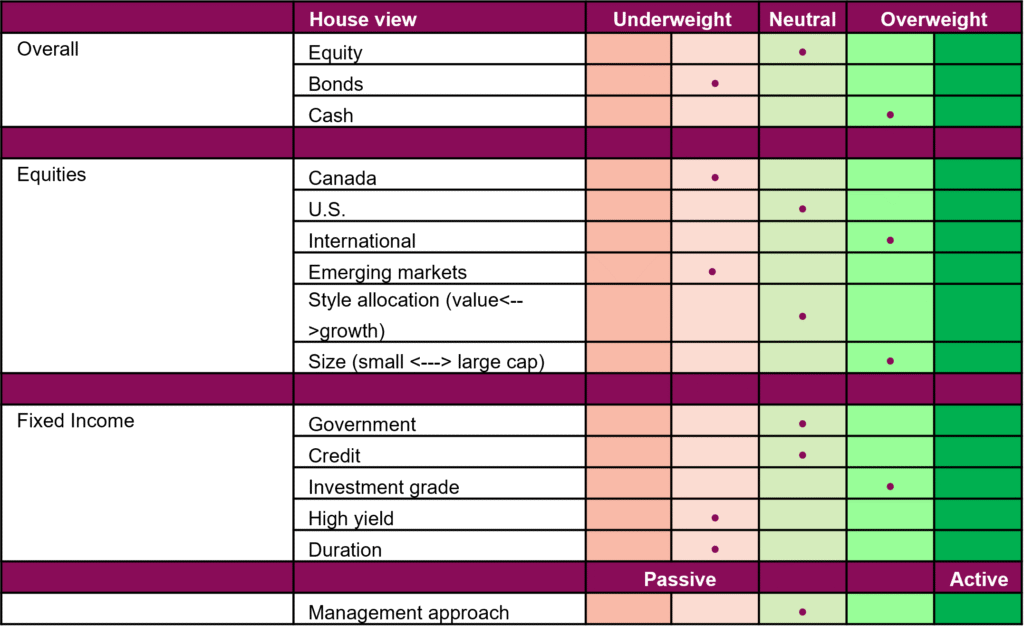
Overall, we have a slightly defensive stance. Encouraged by economic and earnings data, we have a defensive tilt mainly due to the market already pricing in a lot of good news, and it’s our opinion this is a late cycle stage.
Portfolio positioning
Final thoughts
Markets have sort of been rangebound over the past couple of months, but with daily volatility heightened. AI correction is weighing on markets, but good economic and earnings data is supportive. Maybe the pullback in AI is over with Microsoft’s earnings, which resulted in a one-day jump in its market capitalization by +$450 billion. We read this is a record for one-day value creation. Normally we fact check such things, but it would take too long, and it sounds plausible. Once again, there are more characteristics of late cycle and bubble behaviour.
It is encouraging that during this AI pullback, markets held in. If the AI concerns fade, we could see a good leg higher. But given we think this is the second hydration break (promise, last soccer reference) and most portfolios are up nicely, this doesn’t feel like a good time to press (that is the last one).