
Market Ethos
19 May 2026
Watching the clock
Sign up here to receive the Market Ethos by email.
These markets are awe-inspiring and so much fun. Any angst over the Strait of Hormuz global logistics blockage (which is still closed) has faded and been replaced with another round of AI euphoria. This bout has been more focused on memory and semiconductors, turbo boosting many markets that carry higher weights to those industries. Q1 earnings weren’t just technology driven, growth was widespread with most sectors pace in double digits. The global economy is pretty good with a manufacturing upswing. There is a lot of good news, but today we are taking a step back from the recent excitement to get a better look at things.
This looks like late cycle.We are big fans of the market cycle, with our framework of indicators and research into past cycles. Now, the preponderance of data points to late cycle. Let’s stack them up:
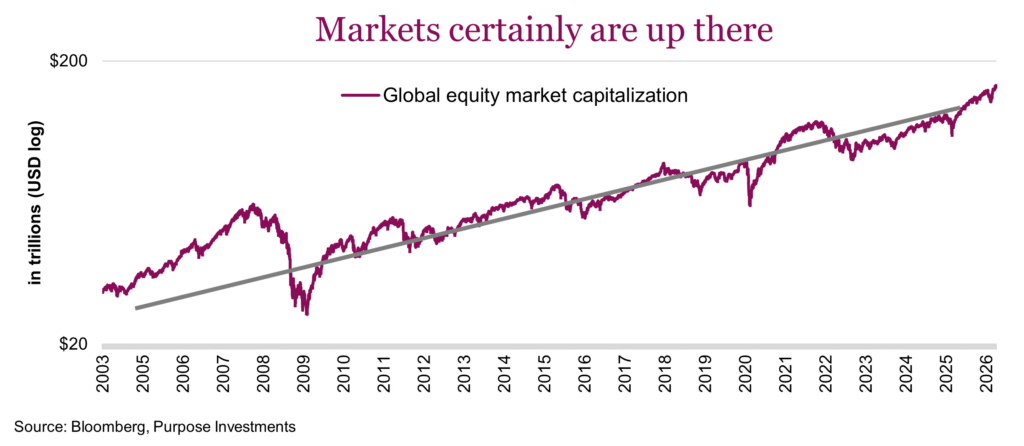
Bubblicious market performance: Few would disagree that equity market returns have gone a bit nutty, in a good way. The S&P 500 having a 20% year feels like the norm now. The TSX just posted a 35% year. Global equity markets have risen about $26 trillion over the past year to $127 trillion. And of course, we can slice more narrowly to look at huge returns in semiconductors, memory, or anything selling into the AI infrastructure build.
The Roundhill memory ETF, launched on April 2, holds a basket of about 10 companies in the memory space, which has been experiencing a shortage. This ETF has reached almost $10 billion in assets in ONLY 42 days. The SOX index, which tracks a basket of semiconductor companies, is up 67% during the past six weeks. Or let’s pick on Cisco, since they were around in the last tech bubble, and we own this name in a few strategies. After an earnings boost from blockbuster sales to hyperscalers, Cisco stock jumped 15% last Thursday to reach an 84% rise over the past year. A great quarter but earnings growth in 2026 is up about +14% and estimates for 2027 are for another +13%. Estimates will come up but 84% price gain vs 13% earnings gain is hard to reconcile regardless of how much of an AI bull you are.
Global market capitalization is now $164 trillion, up a solid $13 trillion so far this year as of only mid-May. We’re seeing big value creation in some very narrow pockets, evident in the narrow breadth of the recent advance. This is late cycle performance.
Inflation/yields/rates: What else is supposed to happen in the very late stage of the market cycle? Inflation, higher yields and higher rates. As the cycle ages, aggregate demand starts bumping up against capacity, causing inflation and yields to rise. Then, central banks are supposed to raise rates with the hopes of cooling aggregate demand and alleviating inflation pressures. Their timing is often terrible and the cycle ends.
Ok, we have inflation rising again. We could blame the Strait of Hormuz blockage, certainly a BIG contributor, but there are many factors at play here. That soft labour market in the U.S. has been firming up. China, historically an exporter of disinflation, now has a PPI well in the positive territory. And all that spending on data centers is pushing prices way up in many categories. We have no doubt AI will enhance productivity, which will be disinflationary, but getting there is very inflationary. Meanwhile resource companies, known to be late cycle strong performers, are booming.
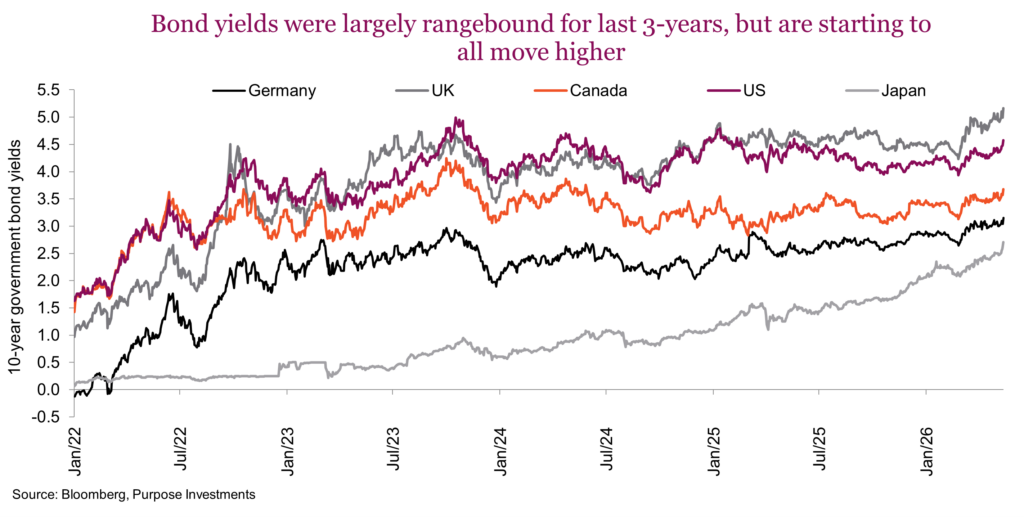
This is starting to lift bond yields. After yields normalized in 2022/23 (doesn’t that make it sound so much less painful than it was?), they have remained rangebound for the past three years, and now are just starting to stir. Inflation, higher inflation, large corporate bond issuances, the list of factors putting upward pressure on yields is a long one. At some point, equity markets will care about yields moving higher. Maybe we got a whiff of that last week.
Add it all up: commodity prices up, incredible spending on AI build out, more companies/countries focusing on supply chain diversification and holding higher inventories (due to disruptions), manufacturing doing well globally, low unemployment … all pushing inflation higher and yields up.
So where is monetary policy? Rate cuts increasingly appear off the table (duh), and the Fed probably should already be hiking. But policy has become more about elongating cycles and less about maintaining price stability. So, the policy mistake is probably not raising rates and the continued unbridled fiscal stimulus avalanche even with economies doing fine.
A game changer: This would be AI. Every cycle has one or a few things going on late in the cycle that end up changing the world in a meaningful way. In the late 1960s into early 1970s, it was the Nifty 50, with new technologies and companies increasingly going global. The 1980s cycle was lifted by leveraged buyouts and deregulation, plus Japan taking over the world (economically). The 1990s of course was dotcom. In the early 2000s, it was China’s growth driving commodities and the explosion in housing. In the 2010s, it was the rise of corporate debt and the fall in yields.
AI certainly fits the bill as a technology that will change many parts of society and have a number of meaningful economic impacts. Even if it doesn’t live up to all the expected productivity gains or ROI (not our view, we said ‘if’), the infrastructure buildout alone is enough to drive the economy.
Late cycle
The good news is that even if it is late cycle there are only a few economic cracks, and they are certainly manageable. Even higher yields, which may upset the market, can be absorbed as long as economic growth continues, earnings grow and AI excitement continues. The dotcom cycle handled 10-year U.S. Treasury yields in the 6-7% range. The housing cycle in the early 00s handled yields of 5%, with housing very sensitive to financing costs. Plus, the late cycle phase is also characterized by strong price gains. Not as much as the early cycle phase, coming off the previous bear market bottom, but strong returns nonetheless.
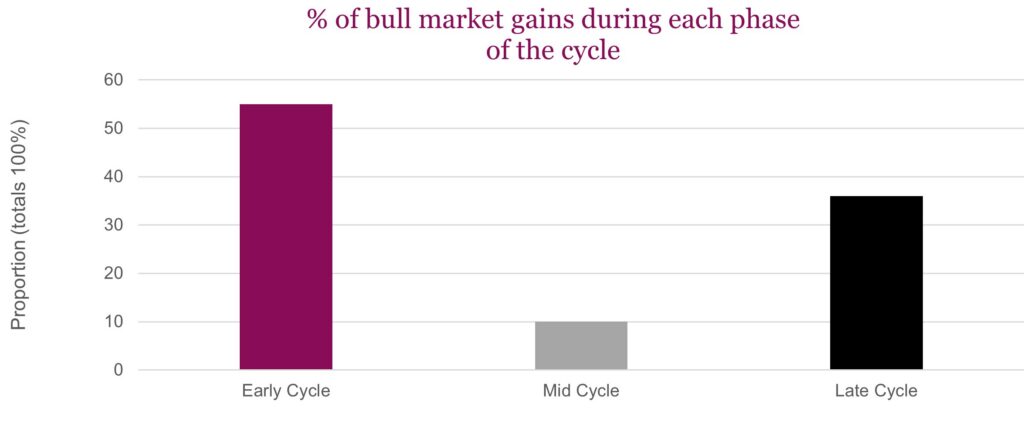
Our favorite analogy is that the Bull and Bear have started to fight it out. This phase has bigger market swings, both up and down as the conflict continues. Spoiler alert: the cycle will eventually end and the Bear wins, with the real question being how long the fight will last. This is where we believe we are in the cycle.
Last dance implications
If memory serves, the last dance is characterized by a longer song with slower music. The good news is the music is still playing, and the pace of the music has not slowed too much. There’s always the possibility there will be an encore as those policy makers remain emboldened about trying to elongate cycles, regardless of the impact on prices, income disparity or other side effects.
The trigger that marks the end of a cycle is different every time. A few potential triggers that we are watching more closely include:
- Some highfliers start to miss very high earnings expectations.
- Rates, or more likely bond yields rising too much. Inflation would lead to this too.
- The weight of it all. Sometimes cycles end because the winners simply become too big to support their own weight.
Or something new that is different than any past cycle.
From a portfolio perspective, it’s important to keep in mind that over the past few years, many clients have enjoyed outsized returns. Many are likely well above their financial plan flight path. Even with the music still playing, it’s not crazy to de-risk a bit. We are still dancing but have a moderately defensive tilt. We’re trying not to leave the dance early, but we also we also don’t want to miss curfew.